The work was very structured, process-oriented, and largely administrative . Most governance models were built around the assumption that enterprise systems changed slowly and that risk could be managed through static controls.
That assumption no longer holds.
With the connected architecture and many improvements in SAP, modern environments are significantly more complicated than they were even five or six years ago. Organizations are no longer securing a single ERP platform. They are managing interconnected ecosystems that span SAP S/4HANA, SAP Business Technology Platform (BTP), SuccessFactors, Ariba, APIs, cloud identity providers, analytics platforms, automation tools, and third-party SaaS applications. In many enterprises, business processes now move across multiple systems before a single transaction is completed.
The result is that SAP Security teams are being asked to govern environments that are not only larger, but far more dynamic than traditional governance models were designed to handle.
This is one of the reasons AI is becoming such an important discussion within SAP Security.
Not because AI is replacing security teams. And not because every enterprise suddenly wants “AI-powered governance.” In reality, most organizations are simply reaching a point where manual governance processes are becoming difficult to sustain operationally.
- Access reviews continue growing.
- Role structures continue expanding.
- Cross-system risks are harder to identify.
- And security teams are expected to move faster with fewer resources.
At some point, traditional approaches begin to struggle under their own weight.
AI is starting to matter because it introduces something SAP Security has historically lacked: the ability to continuously interpret patterns and context at scale instead of relying entirely on predefined rules and periodic reviews.
The shift is much bigger than automation alone.
SAP Security Has Historically Been Treated as a Supporting Function
Part of the challenge facing SAP Security today is rooted in how the discipline evolved historically inside large transformation programs.
For years, SAP Security was rarely positioned as a strategic capability on its own. In many ERP implementations, it was treated as a supporting workstream alongside Basis, testing, or functional delivery activities. System integrators often approached SAP Security primarily from a provisioning and compliance perspective rather than as a long-term enterprise risk discipline.
That approach worked reasonably well when SAP environments were smaller, centralized, and relatively stable. But modern enterprise ecosystems no longer operate that way.
As organizations expanded into cloud platforms, APIs, third-party integrations, and distributed identity models, many of the limitations of those earlier governance approaches started becoming visible. Role sprawl, fragmented SoD frameworks, excessive access accumulation, and inconsistent governance maturity are often symptoms of SAP Security historically being underinvested as a strategic function.
AI is now forcing organizations to rethink that model entirely.
Why Traditional SAP Security Models Are Under Pressure
Most SAP Security frameworks still operate as if enterprise risk is relatively static. That made sense years ago when organizations primarily managed centralized ERP systems with stable business processes and fewer external integrations.
Modern enterprise environments do not behave that way anymore.
A procurement process today may involve SAP S/4HANA, Ariba, external vendor systems, cloud workflow engines, APIs, and non-SAP applications simultaneously.
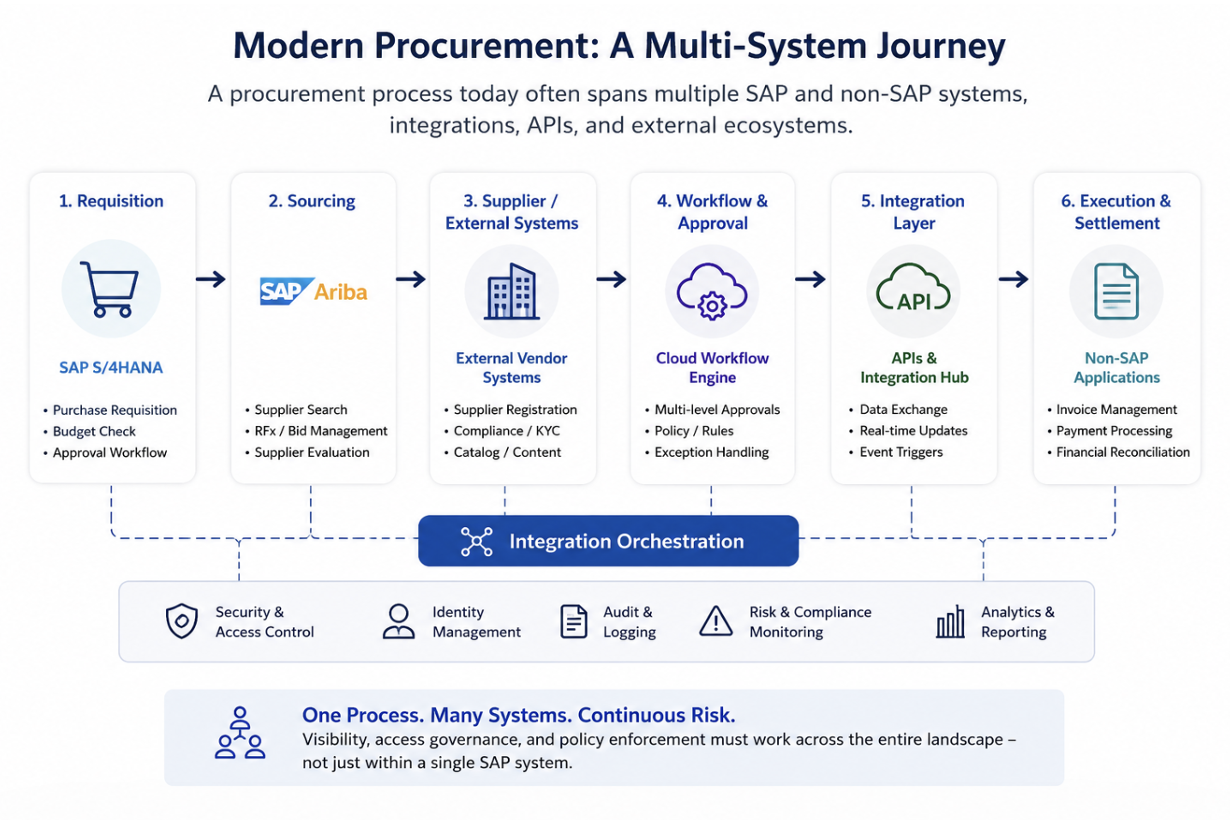
This level of interconnectedness is fundamentally changing how enterprise risk must be evaluated across SAP ecosystems.
User access changes more frequently, integrations introduce new risk paths continuously, and business functions evolve faster than governance teams can redesign authorization models. This creates a problem that many organizations quietly struggle with.
The issue is no longer just managing access. The real challenge is maintaining visibility into how access behaves across an increasingly distributed environment.
Many enterprises now maintain thousands of SAP roles accumulated through acquisitions, transformation programs, temporary projects, and years of incremental changes. In some cases, nobody fully understands why certain authorizations still exist. Access reviews become exercises in validation rather than meaningful governance because managers are reviewing entitlement volumes that are simply too large to interpret carefully.
The same pattern is visible in SoD governance as well.
Traditional SoD models are still heavily dependent on static rules. But modern business risks often emerge through relationships between systems, workflows, APIs, and user behaviour rather than isolated authorization conflicts inside a single SAP application.
That is where AI starts becoming relevant in a practical sense.
Not as a futuristic concept, but as a response to operational complexity that traditional governance models increasingly struggle to absorb.
SAP Security Is Entering the Age of Intelligent Governance
One of the biggest shifts AI introduces is philosophical rather than technical.
Traditional SAP Security is fundamentally rule-driven . Access is requested, approved, provisioned, reviewed, and eventually removed through predefined governance workflows. Most controls are designed around policies established in advance.
The challenge is that enterprise risk does not always behave predictably anymore.
The same authorization may represent low risk in one situation and elevated risk in another depending on timing, user behaviour, transaction context, geographic location, or surrounding activities. Static models are not very good at understanding those nuances.
AI changes that dynamic because it allows security systems to evaluate patterns, relationships, and context instead of relying entirely on static rule validation.
Most organizations underestimate how significant this shift actually is.
In traditional SAP Security, the primary question was:
- “Does this user violate a control?”
Increasingly, AI-driven systems are asking:
- “Does this behaviour look risky based on context?”
Those are fundamentally different security models.
And honestly, this transition was overdue. Most SAP Security environments became too complex for purely manual governance years ago. Organizations just continued adding more reviews, more workflows, and more controls to compensate for the growing complexity.
AI is beginning to shift that model toward something more adaptive.
Some enterprises are still heavily dependent on manual governance models and reactive controls. Others have already started experimenting with behavioural analytics, intelligent provisioning, and AI-assisted risk analysis.
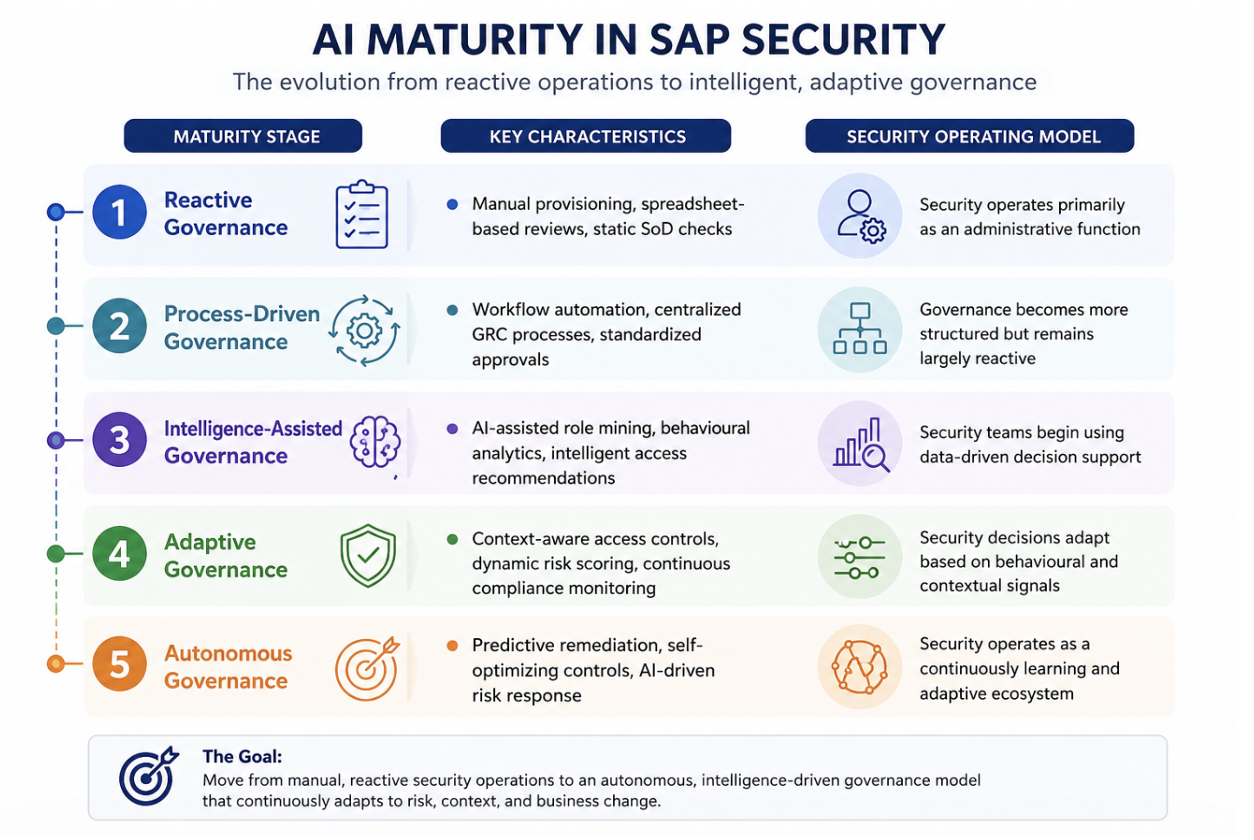
In practice, SAP Security maturity is gradually evolving through several distinct stages.
AI Maturity in SAP Security
What makes this transition particularly interesting is that organizations are not all evolving at the same pace.
Some enterprises still operate with highly manual governance models built around spreadsheets, reactive reviews, and traditional SoD controls. Others have already started introducing behavioural analytics, intelligent provisioning, AI-assisted role mining, and adaptive risk monitoring into their security operations.
In practice, SAP Security is gradually moving through a broader maturity evolution - from administrative governance toward intelligence-driven and continuously adaptive security models.
The progression below illustrates how SAP Security operating models are beginning to evolve in the age of AI.
AI Is Quietly Reshaping the Economics of SAP Security
One area that receives far less attention in AI discussions is operational economics.
Historically, SAP Security has been heavily labor-dependent. Large enterprises often maintain sizable support teams responsible for provisioning, role maintenance, access reviews, SoD remediation, audit preparation, and operational governance activities. As SAP landscapes expanded, organizations typically addressed growing complexity by adding more people, more workflows, and more administrative controls.
That model is becoming increasingly difficult to sustain.
In some organizations, access review cycles already consume thousands of manager hours annually, yet very little of that effort materially improves security posture.
AI is beginning to change the economics of SAP Security by reducing the amount of manual analysis required across several high-effort activities. Intelligent role mining can significantly reduce the time required for authorization remediation projects. AI-assisted access reviews help organizations focus reviewer attention on genuinely risky entitlements instead of low-value approvals. Behavioural analytics can reduce investigation effort by prioritizing abnormal activity patterns more effectively.
More importantly, organizations are starting to realize that the largest ROI may not come from operational efficiency alone.
In many cases, the greater value comes from reducing long-term security debt.
Poor role design, excessive access accumulation, fragmented governance models, and delayed remediation efforts create hidden operational costs that compound over time. AI-driven governance models help organizations identify and correct these issues earlier before they become large-scale remediation programs.
This is one reason many enterprises are beginning to view AI in SAP Security not simply as an automation initiative, but as a long-term risk optimization strategy.
User Behavioural Analytics (UBA) Is Quietly Becoming One of the Most Important Areas in SAP Security
While role optimization addresses one side of the challenge, organizations are increasingly realizing that governance alone is not enough. The bigger issue now is visibility into user behaviour after access has already been granted.
This is where many traditional monitoring strategies begin to break down.
Modern SAP environments generate far too much activity for static rule-based monitoring to remain effective on its own. Security teams can create alerts for known scenarios, but insider threats and compromised accounts rarely behave in perfectly predictable ways.
Behavioural analytics approaches the problem from a different angle. Instead of relying entirely on predefined violations, AI systems continuously learn normal patterns of activity and identify deviations that may indicate elevated risk.
A finance user executing BASIS transactions late at night may not violate a traditional SoD rule directly. But combined with unusual login behaviour, abnormal data extraction patterns, or unexpected geographic access, the overall context becomes difficult to ignore.
That is where behavioural analytics becomes powerful. It evaluates relationships between activities rather than isolated events.
The Emerging SAP AI Security Architecture Looks Very Different
As organizations adopt AI capabilities, SAP Security architecture itself is beginning to evolve.
Traditional architectures were largely centered around role-based access control (RBAC), workflow approvals, centralized governance processes, and static authorization structures. Those models worked reasonably well when enterprise environments were relatively stable.
AI introduces a different reality because intelligent systems depend heavily on context, continuous analysis, and behavioural interpretation.
The emerging architecture is therefore becoming less focused on isolated controls and more focused on connected intelligence layers.
Identity is no longer viewed simply as a collection of assigned roles. AI-driven systems increasingly evaluate users through behavioural context, organizational relationships, access history, risk posture, and transaction patterns together.
This is closely connected to the growth of behavioural analytics platforms capable of monitoring transaction activity, privileged access usage, workflow behaviour, and data movement patterns continuously across systems.
What is interesting is that governance itself is also becoming part of the architecture now.
Historically, governance was often treated as a process layer around SAP Security. AI changes this because organizations now need mechanisms to validate how AI-driven recommendations are made, whether risk models are explainable, and how automated decisions can be audited.
In other words, AI governance is becoming part of the security architecture itself rather than a separate compliance concern.
Over time, this may become one of the defining architectural shifts in SAP Security.
The NIST AI Risk Management Framework
As organizations move toward AI-driven governance models, one issue keeps surfacing repeatedly: trust.
Some organizations are attempting to introduce AI into SAP Security environments that still rely heavily on spreadsheets for access governance. In practice, AI often exposes governance immaturity faster than it solves it.
- Can AI-generated recommendations be explained?
- Can behavioral risk scoring be validated?
- Can automated decisions be audited consistently?
And perhaps most importantly, who is accountable when AI systems make poor security decisions?
This is exactly why the National Institute of Standards and Technology AI Risk Management Framework (AI RMF) is becoming increasingly important.
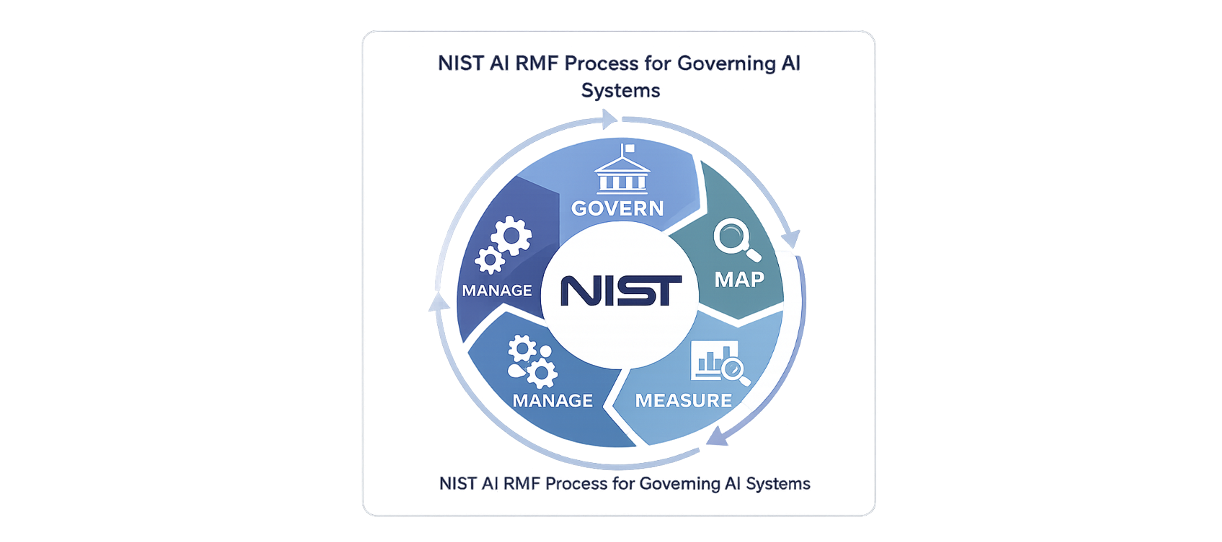 The framework matters because it shifts the conversation away from AI capability alone and toward responsible AI governance.
For SAP Security teams, this changes the conversation entirely.
Many organizations initially approach AI primarily as an efficiency initiative. They want faster provisioning, smarter monitoring, reduced review effort, and lower operational overhead. Those benefits are certainly real. But over time, the larger challenge becomes governance maturity rather than automation itself.
- AI systems influence decisions.
- Decisions introduce risk.
- And risk requires accountability.
The NIST AI RMF provides a structured approach for governing AI systems responsibly through principles focused around governance, risk mapping, measurement, and continuous management.
What makes the framework especially relevant for SAP Security is that it aligns closely with how mature security organizations already think about enterprise risk. The framework emphasizes explainability, oversight, validation, and continuous monitoring rather than blind trust in automated decision-making.
That is important because the future risk in SAP Security may not come from missing SoD rules alone. It may come from organizations introducing AI-driven security decisions without sufficient governance maturity to validate them properly.
And frankly, some organizations are already closer to that problem than they realize.
The Future Role of SAP Security Professionals
There is a growing assumption that AI will eventually replace large portions of SAP Security work.
Some operational tasks almost certainly will become heavily automated over time. Manual provisioning analysis, repetitive access reviews, static role analysis, and certain governance workflows are already moving in that direction.
In fact, this transition has already started quietly across many enterprises.
A large percentage of traditional L1 and L2 SAP Security activities are highly repetitive and rules-based by nature. Tasks such as password resets, user unlocks, validity extensions, basic provisioning requests, and standard access approvals increasingly require little human intervention.
For years, organizations depended on large operational support teams to handle these activities manually. But from an architectural perspective, many of these tasks were always candidates for automation. AI is simply accelerating a shift that was already beginning through workflow automation and identity governance platforms.
What changes now is not automation itself, but the level of intelligence behind it.
Instead of executing predefined workflows alone, AI-driven systems can increasingly interpret context, evaluate risk, recommend approvals, identify anomalies, and adapt decisions dynamically. This reduces operational dependency on repetitive support activities and allows security teams to focus more heavily on governance, architecture, risk analysis, and strategic oversight.
The long-term impact is not necessarily smaller security organizations. More likely, it is a redistribution of effort away from transactional administration and toward intelligent governance.
But the broader conclusion that SAP Security professionals become less important is probably incorrect.
If anything, the role is becoming more strategic.
As AI-driven governance models mature, organizations will need professionals who understand not only SAP Security, but also business risk, identity governance, AI oversight, enterprise architecture, and regulatory accountability.
The future SAP Security architect will likely spend less time managing individual roles and more time governing intelligent trust models across enterprise ecosystems.
That is a very different role than traditional SAP Security administration.
And honestly, it is probably where the discipline needed to evolve eventually anyway.
Conclusion
The future of SAP Security will not be defined by who automates the fastest.
It will be defined by which organizations build governance models mature enough to support intelligent decision-making responsibly.
AI will absolutely change how SAP Security operates. Some administrative functions will disappear quietly over time. Others will evolve into intelligence-driven governance disciplines that barely resemble traditional SAP Security operations today.
But the organizations that succeed will not be the ones chasing automation blindly. They will be the ones capable of balancing AI-driven efficiency with architectural discipline, explainability, accountability, and human oversight.
Because ultimately, enterprise trust cannot be automated entirely.
The views and opinions expressed in this article are solely those of the author and are intended for informational and educational purposes only. They do not represent the official views of any organization, employer, client, or technology vendor. Organizations should evaluate AI, governance, and security strategies based on their own business, regulatory, and operational requirements.