From access mirroring to shared CPIC users: how well-intentioned decisions quietly build into systemic over-privilege, and what to do about it.
SAP access risk rarely appears overnight. In most enterprises, it accumulates gradually through practical decisions made under delivery pressure: reuse an existing technical ID, mirror access from a colleague to speed onboarding, keep a project test user active “for now,” or postpone cleanup until after go-live. Each decision seems reasonable in isolation. Over time, they create systemic over-privilege that becomes difficult to unwind.
That gap is not a tooling problem. It is a governance design problem. And in environments where automation, shared identities, and complex process dependencies are the everyday reality, it has a predictable, damaging effect: security teams end up managing a backlog of risks they fully understand but cannot fix quickly.
This article examines six common but under-discussed patterns that quietly increase SAP access risk, especially in mature environments running automation, interfaces, shared identities, and legacy role models. It also outlines practical governance actions that reduce exposure without disrupting legitimate business controls.
GOVERNANCE LATENCY, DEFINED
A useful concept for SAP security programs is governance latency: the time between identifying an access issue and implementing an approved corrective action.
In large SAP landscapes, remediation often requires coordination across security teams, business process owners, Basis teams, auditors, and change management functions. Even when everyone agrees a risk exists, closure may take weeks. During that period, the risk remains active, known, and accepted by default.
This is not simply an operational inefficiency. It is a governance design challenge.
1. The Identity Assumption That Stopped Being True
SAP role design was built on a straightforward premise: a user is a person doing a job. Every governance model, every SoD framework, every access review process carries that assumption forward. It made sense when it was written.
Most production SAP landscapes now include at least four identity types that behave very differently from each other:
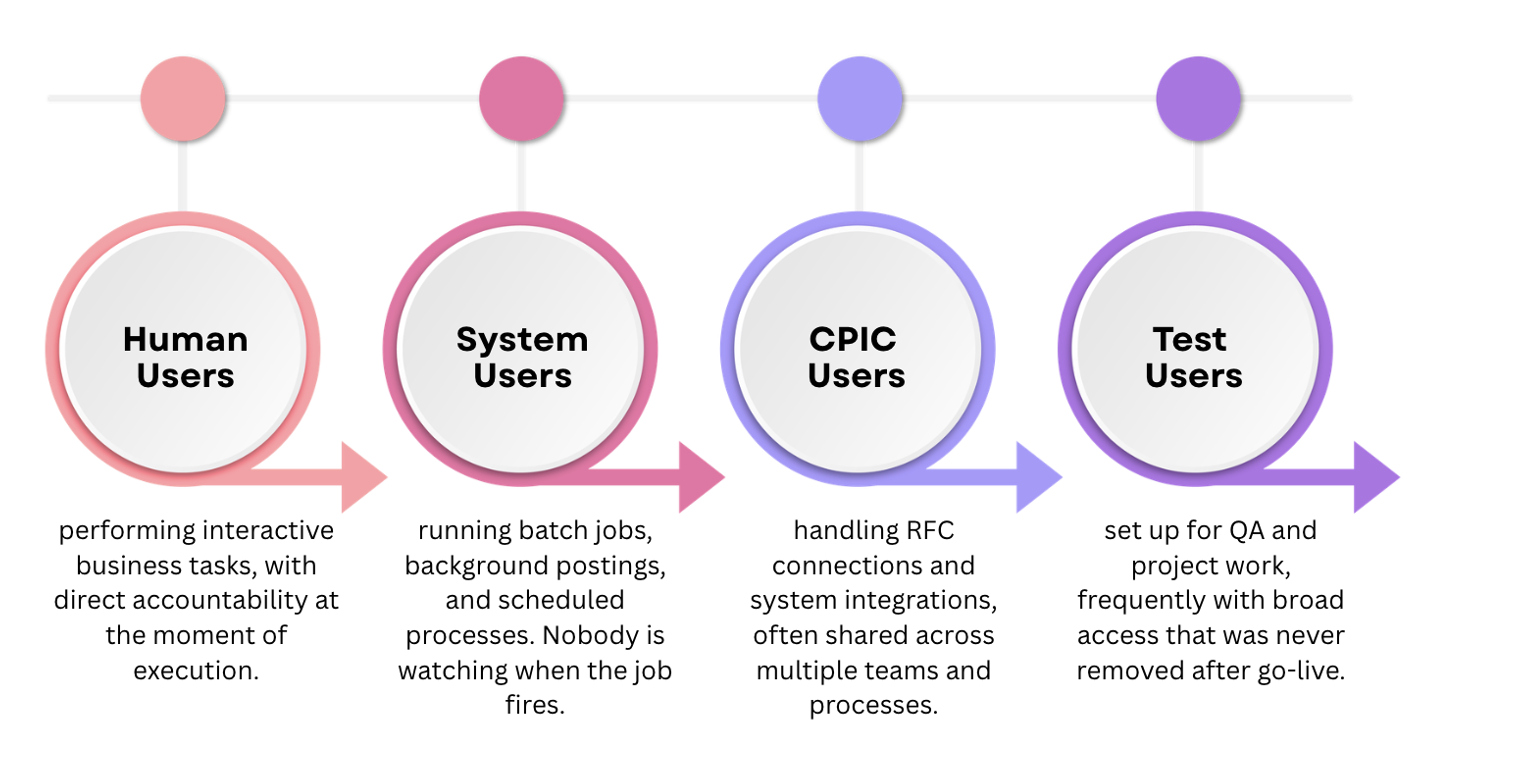
- Human users performing interactive business tasks, with direct accountability at the moment of execution.
- System users running batch jobs, background postings, and scheduled processes. Nobody is watching when the job fires.
- CPIC and service users handling RFC connections and system integrations, often shared across multiple teams and processes.
- Test users set up for QA and project work, frequently with broad access that was never removed after go-live.
In many organizations, these identities are granted the same business roles because designing separate control models requires additional budget and governance effort. The role matrix may look compliant, but the accountability model behind it has changed completely. For example: A finance clerk role assigned to a human user and the same role assigned to a batch job look identical in the role matrix. The accountability gap between them does not show up there.
2. Six SAP Access Risk Patterns That Build Quietly
Pattern 1: Silent Automation
System users execute financially significant transactions such as invoice postings, vendor updates, payment runs, and scheduled jobs. When a posting is wrong, or an update was not supposed to run, no individual made that call. The audit trail records what happened; it does not help you understand who decided it should happen. Attribution is hard. Remediation is harder.
Pattern 2: Role Reuse Across Identity Types
A single business role assigned to a human user, a batch job, a service account, and a test user is one of the most common configurations in a mature SAP landscape. Each of those identity types is governed differently, monitored differently, and carries different accountability assumptions. The role treats them the same. That is where the gap is.
Pattern 3: Test Access That Outlives the Project
Test environments mirror production, so test users need broad access to work realistically. That access rarely gets cleaned up on schedule. Cleanup gets pushed to the next sprint, then the next quarter, and eventually the access stays. After a few cycles of this, broad test-era access becomes the unexamined baseline for how roles get designed in production. Nobody questions it because it has always been there.
Pattern 4: The Access Mirroring Trap
This one catches people off guard, including experienced access teams. The request looks routine: a new joiner is joining the same team as an existing colleague, and the liaison is requesting that their access be mirrored. The access team copies the colleague's role assignments across.
What they are actually copying is that colleague's full access history.
The source user may have picked up a vendor master write role during a migration project two years ago, which was meant to be temporary but was never closed. They may have had cross-company posting access granted while covering for someone on leave, never removed. There may be a GRC bypass role that was escalated during an incident and formally forgotten about after the situation was resolved.
When the mirror runs, the new user inherits all of it. Every forgotten temporary assignment, every project role that slipped through access review, every exception that became permanent by neglect. The provisioning request is processed cleanly. The over-privilege is invisible inside it.
SCENARIO
User X is a finance analyst. Standard AP role set, plus: a vendor master write role from a 2022 migration project (still open), a cross-company posting role from interim cover (never removed), and a GRC bypass granted during an emergency (never formally closed). A new joiner, User Y, is mirrored to User X. User Y has all of it from day one, and no individual role was intentionally granted to them.
The provisioning request looks clean. The access history behind it does not.
Pattern 5: Shared CPIC and Batch User Sprawl
CPIC users and batch users are created with a specific purpose in mind. That specificity rarely survives contact with the next project that needs something similar.
A batch user built for the month-end close gets borrowed by Procurement for a reporting job. A CPIC user set up for an SD-to-FI interface gets reused for an MM integration because it already has the authorizations someone needs - and creating a new user requires a ticket, an approval, and a week of waiting. Each reuse is a small pragmatic decision. Over a few years, that user has accumulated roles from three teams and runs jobs for five different processes.
At that point, it has no meaningful owner. Ask who is responsible for it, and you will hear the names of multiple teams, none of whom can account for what the others have added. In an audit, all three teams approve the user's access because they each depend on it. None can explain the roles assigned by the others.
Any attempt to remediate that user without coordinating across all dependent teams risks breaking something. That coordination takes time. So the user stays the same, and the next audit produces the same result.
SCENARIO
A CPIC user created for an SD-to-FI integration is later used by MM for a procurement interface, then by Basis for system monitoring. After three years, it holds roles from all three areas - no single owner. In the access review, all three teams approve it because each depends on it, but none can account for the roles the others added.
A technical user with broad multi-domain access, no accountable owner, and no realistic path to quick remediation.
Pattern 6: Accountability Collapse on Shared Identities
When multiple processes or teams share a technical user, accountability for what that user does becomes genuinely unclear. A transaction executed by a shared batch user has no meaningful owner. An anomalous posting cannot be traced to a decision. The audit trail tells you what happened, but gives you nothing useful about why. This is a structural problem, not an operational one, and it does not resolve on its own.
WHY THESE PATTERNS COMPOUND
A shared CPIC user accumulates roles from multiple teams, some of which were originally granted during a test phase, some copied in via a mirroring request against a colleague with an unreviewed access history. Each layer is justifiable on its own. Together, they produce a risk surface that no single team owns, and no single approval process can quickly reduce.
3. Why Fixing It Takes So Long
When a security team flags one of these patterns, the remediation path requires passing through several layers that each have legitimate reasons to exist:
- Security identifies the risk: An over-privileged batch user, mirrored access with inherited exceptions, and a shared CPIC user with no clear owner.
- A liaison team interprets the business context: What process does this support? What breaks if the access changes?
- Business owners assess the operational impact: Is the access still needed? Who else depends on it? When is it safe to change?
- A change is approved, scheduled, tested, and implemented, documented throughout for audit purposes.
For a clean finding, that sequence takes two to four weeks in a typical enterprise environment. For anything involving shared technical users tied to production processes, it takes longer because the risk of a misapplied change to a shared user is concrete and immediate. In contrast, the risk of leaving it another cycle feels abstract and distant.
Security teams often end up maintaining a list of findings they understand completely but cannot close. The risk is known. The remediation timeline is not within their control. That is governance latency in practice, and it is where over-privilege becomes structural rather than incidental.
It is worth saying clearly: the governance model is not the problem. Distributed ownership, documented approvals, and structured change management are in place because access changes in production systems carry real operational risk. The issue is that this model was not designed with non-human identities in mind, and it does not handle the patterns above well.
4. What to Do About It
The patterns above are governance problems, but they do not need a governance overhaul to address. Each step below is a targeted intervention at the points where risk most reliably accumulates.
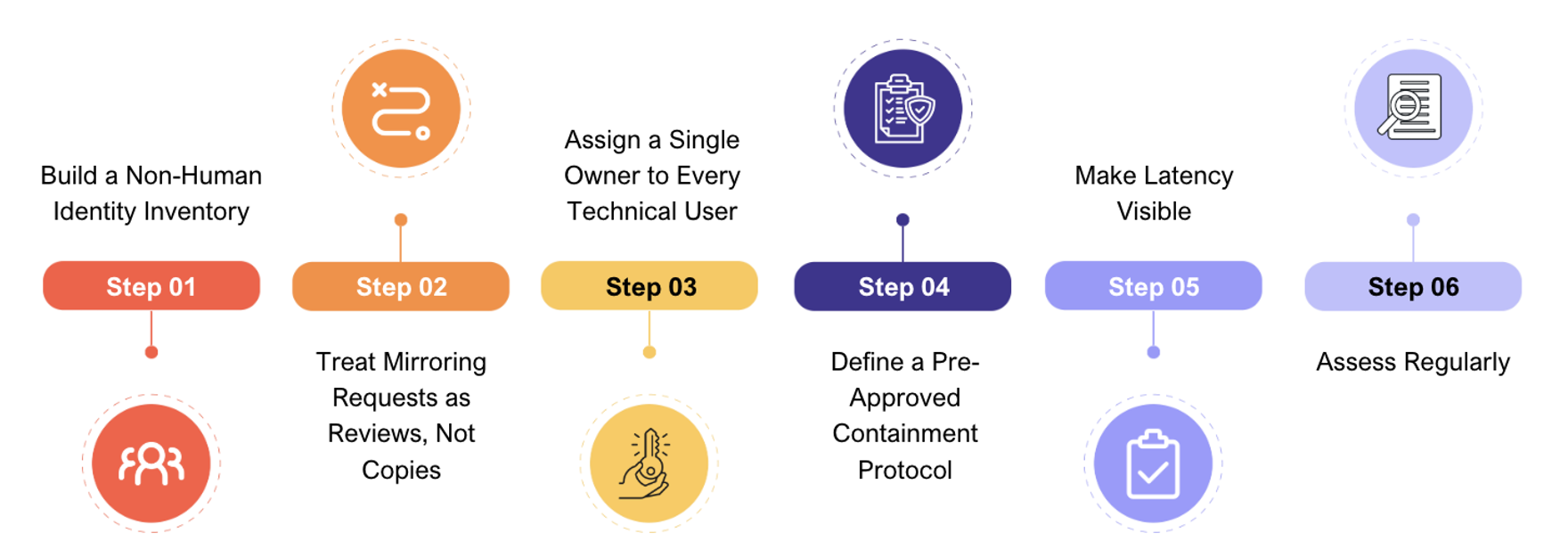
Step 1: Build a Non-Human Identity Inventory
Pull a list of all active System, CPIC, and background users in your production landscape. For each one, record what it is used for, which teams or processes depend on it, and who the named owner is, a named individual, not a team.
This exercise alone will surface most of the unowned and over-scoped technical users in your environment. It is also the prerequisite for every other step. You cannot govern what you have not cataloged.
Step 2: Treat Mirroring Requests as Reviews, Not Copies
Before mirroring access from a source user to a new joiner, you can go over what is actually on the source profile, not the roles that should be there, the roles that are there. Any role that cannot be justified against the new user's current job function should be excluded from the assignment rather than forwarded along.
This is a one-question addition to the current provisioning process: is every role on this profile still valid for the function being mirrored? It will catch accumulated exceptions before they replicate, and surface source users whose access has drifted, which is a remediation opportunity in itself.
Step 3: Assign a Single Owner to Every Technical User
Every CPIC user, batch user, and service account needs one named owner who is accountable for its access. In practice, shared ownership means no ownership. The owner should be the person who can explain at any given moment why each role on that user's profile is necessary and still in scope.
For users currently shared across teams, forcing a single owner will make the coordination problem visible and explicit. That visibility is the first step toward resolving it.
Step 4: Define a Pre-Approved Containment Protocol
Security teams should not need to complete a full four-step approval cycle before taking any protective action on a critical finding. A pre-approved containment protocol establishes, in advance and with business agreement, the conditions under which a high-risk identity can be temporarily locked or scoped down. At the same time, the formal remediation process runs in parallel.
Agree on the trigger threshold, who can invoke it, what the restriction looks like, and when a formal decision must be made. This gives security teams a way to act on acute risk without bypassing governance and to operate within pre-agreed boundaries, rather than waiting for permission.
Step 5: Make Latency Visible
Track the time between when findings are raised and when they are closed, segmented by identity type. Report it. When business and security leadership can see that a batch-user finding raised in January is still open in March, they can decide what to do about that. When the metric is invisible, there is no pressure to change the underlying process.
6. Assess Regularly
Access governance cannot be a once-a-year exercise driven only by audit calendars. SAP environments change continuously through new projects, integrations, role updates, automation changes, support fixes, and business restructuring. If assessments are infrequent, privilege creep and ownership gaps return faster than most organizations realize.
Establish a recurring review cadence for human and non-human identities, high-risk roles, shared technical users, SoD conflicts, and dormant access. Quarterly risk assessments for critical areas and continuous monitoring for sensitive identities create a far stronger control posture than periodic cleanups. Regular assessment turns access governance from reactive remediation into an ongoing discipline.
Final Perspective
Most SAP access issues are not caused by malicious intent or obvious negligence. They emerge from sensible short-term decisions repeated across years of projects, upgrades, integrations, and operational pressure.
That is why mature access governance must evolve beyond role matrices and periodic reviews. It must address how privileges accumulate, how technical identities drift, and how remediation delays turn known risks into permanent exposure.
The strongest starting point is simple: review your non-human identities before your next audit does.