What Is the Difference Between an SAP Security Consultant and an SAP Security SME?
An SAP Security Consultant typically implements, maintains, or troubleshoots SAP access controls according to their role and responsibilities. An SAP Security Subject Matter Expert (SME) demonstrates a deeper understanding of authorization concepts, business processes, control objectives, and the reasoning behind security decisions. The roles can overlap; the difference lies in the depth of knowledge demonstrated, not simply the job title or years of experience.
Over my 25+ years in SAP Security, interviewing professionals has taught me one important lesson: There is a thin line between performing security activities and truly understanding SAP Security —and that line makes all the difference.
Over the years, I’ve had the pleasure of interacting with and interviewing SAP Security professionals from different backgrounds, with different levels of experience and project exposure.
One thing I’ve noticed is that years of experience, the number of projects completed, and the skills listed on a résumé do not always tell the full story.
Someone may have spent years creating roles, provisioning users, handling access requests, and supporting SAP Governance, Risk, and Compliance (GRC) activities. That experience has value. But it does not automatically mean the person understands the underlying authorization concepts, business processes, or security decisions.
This is where I see a meaningful difference between an SAP Security Consultant and a subject matter expert (SME) .
A consultant may be very good at executing a defined activity. An SME should be able to explain why that activity is required, how it works, what risks it addresses, and what could go wrong if it is implemented incorrectly.
Of course, these are not mutually exclusive roles. A strong consultant can also be an SME. The distinction is about the depth of understanding, not the job title.
I’ve listed nine of my observations below from SAP Security interviews that I believe are worth noting:
Observation # 1 - Creating roles is not the same as understanding authorizations.
I have seen candidates who can create roles, assign transactions, maintain users, and troubleshoot basic access issues. They are good at explaining the difference between single, master/derived, and composite roles. However, when I ask these candidates to explain the authorization objects related to a business process, they struggle to provide a clear answer. If somebody says they have extensive experience in creating roles, I would expect that person to know the relevant authorization objects, what these objects control, and how organizational restrictions affect access.
Knowing how to add a transaction to a role is simple, and quick training can make you proficient. Understanding the authorization checks that determine what a user can actually do is what matters most.
The real test is not whether you can build a role. It is whether you can explain why the role grants access and what risk it brings.
Go back and select the last five functional roles you created across different modules. Identify the key authorization objects and fields used to restrict access, and explain the purpose of each restriction.
Observation # 2 - Generic authorization objects cannot replace functional knowledge.
When I conduct interviews, I sometimes ask candidates to name five authorization objects relevant to a functional area (e.g. FI, MM, QM).
Some of them respond with technical authorization objects such as S_TABU_DIS or S_USER_GRP.
If a candidate claims expertise in a functional area, I expect them to identify relevant business authorization objects and explain how they apply to actual activities.
For example, which authorization controls are relevant when a user creates or changes a purchasing document? What are the checks that limit user activities? How do the organization values influence the outcome?
The precise answer depends on the process and system configuration. That’s why it’s important to know the context.
Memorizing object names is not expertise. Knowing when an object matters, what it controls, and how to investigate an authorization failure is much more valuable.
Identify one key authorization object for each functional area. For example, consider F_BKPF_BUK in Finance. Understand which organizational element the object controls and which field enforces that restriction.
Observation # 3 - SAP Security consultants must understand the end-to-end business processes.
SAP Security does not exist in a vacuum. It is about much more than user management or adding transaction codes and Fiori apps to roles. As a security consultant, you must understand business processes to design effective roles and apply appropriate authorization restrictions.
Let’s consider a procure-to-pay process. A security professional should understand how purchasing, goods receipt, invoice verification, and payment fit together, and why access across these activities needs to be controlled. Ask yourself: Without that context, can you design an effective role? Role design becomes a mechanical exercise without this context: collect transaction codes, place them into roles, and assign those roles to users.
Why should a particular user perform one activity but not another? Where could conflicting responsibilities arise? Which organizational restrictions are necessary? What would happen if a user received access beyond their business responsibility?
These are not questions answered by transaction-code knowledge alone. The better you understand the business process, the better equipped you are to design and evaluate SAP authorizations.
Select a specific business process and analyze its complete end-to-end flow. Identify the associated transaction codes and the organizational elements involved at each stage.
Observation #4 – Knowing SAP GRC Modules is not the same as Understanding SAP GRC.
Another area where I see a large gap. I must tell you an incident that happened recently.
The candidate’s resume showed experience with SAP GRC Access Control, SAP IAG Bridge, integrations with cloud solutions like SAP SuccessFactors and Ariba, and several third-party systems. Three or four such projects were listed on the resume. It looked like a solid profile at a glance: 16.8 years of experience, exposure to multiple countries, and experience across several SAP GRC-related areas.
But during the interview the candidate said that he had no experience in SAP GRC implementation and never had a chance to work on an implementation.
I started asking questions about SCIM integrations based on the integrations and project activities listed on the résumé. I soon learned that he was unfamiliar with the concept of SCIM. I then asked him how he integrated SAP SuccessFactors, Ariba and the other systems he mentioned on his resume.
His response was that he had only been given the opportunity to maintain those systems. When challenged in the conversation, he finally admitted that he copied the project descriptions and the project activities from another person's resume.
This was one particular case. In many other interviews, I have encountered candidates who have worked on only a limited set of SAP GRC activities but believe that this gives them a broad understanding of the entire solution.
Knowing SAP GRC does not mean knowing every module, integration, or capability within it. Equally, having worked with a particular module does not automatically mean understanding the underlying configuration, integration architecture, governance principles, or control objectives.
A candidate may have worked with Access Risk Analysis (ARA), Emergency Access Management (EAM), or other SAP GRC capabilities. They may have performed SoD analysis, maintained Firefighter assignments, or coordinated access reviews.
These are valuable experiences. But I also want to understand whether the candidate knows why these activities exist and how the controls work.
Take Emergency Access Management as an example.
Why does an organization use Firefighter IDs? What risks are they intended to address? What is the purpose of assigning owners and controllers? What should happen when emergency access is used? How should the resulting activity logs be reviewed?
Similarly, someone who has worked with ARA should know more than just how to do a risk analysis. They should be able to explain the importance of the results, how the risks are evaluated, and what options exist for remediation or mitigation.
Learning a tool's transactions or functionalities is different from understanding the governance principles, configuration choices, integration mechanisms, and control objectives behind it.
The key is to be clear about what you have actually done, what you understand, and what you are still learning. That distinction matters far more than how many modules or projects appear on a resume.
List your technical strengths, the areas you are confident in, and the topics where you are still a beginner or have limited exposure. Be honest with yourself.
Use a GPT tool to help prepare an ATS-friendly résumé. Avoid unnecessary technical jargon, describe your projects clearly, and ensure that your stated responsibilities and activities accurately reflect your experience and align with the position you are applying for.
Take it one step further. Share the job description (JD) and relevant company information with AI. Ask it to generate potential interview questions based on your résumé and the position. Understand the concepts behind the questions and practice your answers using real examples from your experience.
Get ready. Be honest about what you can do. Use AI as a companion to help you learn and prepare—not as a substitute for your own understanding.
Observation # 5 - “I never had the opportunity” is an acceptable answer - but it should not end the conversation.
Not every SAP Security professional gets exposure to every module, project phase, or technical challenge. I understand that.
If someone has not worked on a particular area, saying so honestly is far better than pretending to have expertise.
But I would also look at how the candidate approaches the unfamiliar topic.
Do they try to reason through the problem? Can they connect it to concepts they already know? Do they ask sensible questions? Can they explain how they would investigate the issue or learn what is required?
For example, a candidate might say:
“I haven't configured that component myself, but I understand the underlying security objective. Here is how I would approach learning the configuration and validating the result.”
That response tells me something important about the person’s problem-solving ability.
On the other hand, repeatedly saying that the manager or a senior consultant in the team handled everything, without demonstrating any understanding of the work or any initiative to learn, raises a different question.
Expertise is not about knowing everything. It is about being honest about what you know and demonstrating the ability to learn, reason, and apply knowledge.
Observation # 6 - Performing SAP GRC activities is not the same as owning the control.
Consider activities such as processing access requests, assigning Firefighter owners and controllers, running SoD analysis, or coordinating periodic access reviews.
These activities are part of many SAP GRC roles. Someone who performs them consistently can develop valuable operational experience.
However, performing a task does not necessarily mean understanding the entire control lifecycle.
Can the person explain why the activity is required? What risk does it address? What happens when the process fails? What evidence demonstrates that the control operated effectively? What should happen when an exception is identified?
For example, assigning a Firefighter controller is an administrative step. Understanding the controller's responsibility, the review process, the handling of exceptions, and the evidence required for accountability demonstrates a broader understanding.
The same principle applies to access reviews and SoD analysis.
I am not suggesting that operational experience is unimportant. Organizations need people who can execute these activities reliably. The point is that the depth of expertise should match the level of responsibility being claimed.
Observation # 7 - A resume can list a technology without proving expertise in it.
SAP Security continues to evolve, and professionals often list multiple areas on their resumes: SAP BW Security, SAP BTP Security, SAP BDC Security, and others.
Broad exposure can be a strength. But each listed skill creates a reasonable expectation that the candidate can explain their actual experience in that area.
I encountered a case where a candidate listed BI/BW Security experience on their resume but had primarily performed user creation. When asked in depth about Analysis Authorizations, the candidate explained that another team handled them. How different is user creation in SAP ECC or S4HANA from user creation in SAP BI/BW or other NetWeaver systems?
There is nothing wrong with creating users or working alongside a specialist. Those are legitimate responsibilities.
The problem arises when limited exposure is presented as end-to-end expertise. If someone says SAP BI/BW Security, I might ask the difference between traditional authorization checks and Analysis Authorizations depending on what the candidate claims to do. If somebody mentions SAP BTP Security, I may ask about the specific security services, identity concepts, or authorization models they actually have worked with.
The questions should reflect the experience claimed - not expect every candidate to know every component.
A resume should accurately communicate what someone has done, what they understand, and where their expertise begins and ends.
That honesty benefits both the candidate and the employer.
Review your résumé at least once a year. Add your recent projects, responsibilities, technical skills, and major achievements. Don't wait until you are looking for a new job to update your résumé.
Certifications: Plan Your Next Step
Identify the next role you want to move into and the skills it requires. Explore relevant certifications from SAP and other reputable providers. Compare their syllabus with your current knowledge to identify gaps. Choose a certification that strengthens your expertise or validates skills relevant to your career goals. Set a target date and create a study plan to achieve it.
Don't just collect certifications to add badges to your résumé. Invest in certifications that build relevant skills and help you demonstrate your expertise.
Observation # 8 - AI can help you prepare - but it cannot replace your understanding.
AI tools have made it easier than ever to prepare for interviews. Candidates can use them to explore SAP authorization objects, understand SAP GRC concepts, generate practice questions, and work through technical scenarios.
I see real value in that.
The concern is not that candidates use AI. The concern is when they rely on generated answers without developing the understanding needed to explain or apply them.
An answer may sound technically impressive, but a simple follow-up question can reveal whether the person understands the concept.
Why does this authorization object matter? Can you give a practical example? What would you check if the expected authorization were missing? How would you approach change in a different business process?
These questions are not tricks. They are ways to understand how someone thinks.
My advice to SAP Security practitioners is simple: As mentioned earlier, use AI as a partner in learning. Ask it to explain unknown concepts, challenge your assumptions, and generate realistic scenarios. Then verify the answers against reliable SAP documentation and test your knowledge in a suitable system or practical exercise. Do not stop at memorizing the response. Make sure you can explain it in your own words and apply it to a real-life situation.
AI should help you become more capable, not help you create the appearance of capability.
Observation # 9 - Project experience should be explainable and verifiable.
Project experience is an important part of evaluating an SAP Security professional. But the project name, client name, or duration alone tells us very little about the individual's contribution.
When a candidate describes a project, I want to understand what they personally did.
Did they design the role model? Configure the controls? Investigate authorization issues? Support testing? Perform SoD analysis? Coordinate access provisioning?
What challenges did they face? What was the outcome?
A person who genuinely performed the work should generally be able to describe the approach, explain the reasoning, and discuss the challenges at a level consistent with their claimed responsibility.
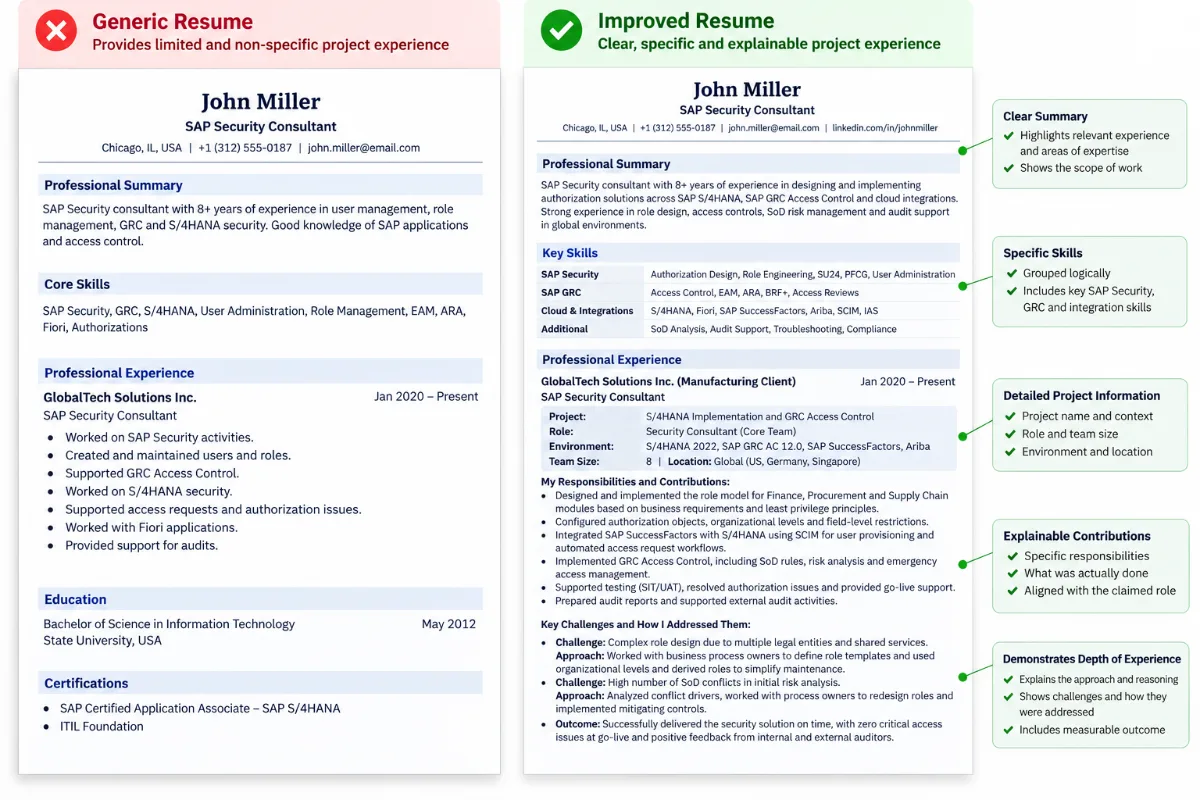
Figure: Generic vs. Improved Résumé — Recommendations for Demonstrating SAP Security Project Experience
Inconsistencies may justify further questions, but they should not automatically be treated as proof of dishonesty. Interviewers need to evaluate evidence fairly and provide candidates a reasonable opportunity to clarify their experience.
The objective is not to catch people out. It is to establish whether the candidate's experience matches the role and responsibilities being discussed.
A clear, specific explanation of a real contribution is often more informative than a long list of projects and technologies.
So, what really differentiates an SAP security consultant from an SME?
Remember... “Experience comes with time. Expertise comes with understanding.”
It’s not just the years in the industry that make you a strong professional. It is the depth of understanding, the ability to relate security to business processes, the quality of technical reasoning, and the ability to apply knowledge when the situation is unfamiliar. An effective SAP Security professional must be able to:
- Describe the role of the appropriate authorization objects and their usage for business activities.
- Understand the end-to-end processes that roles and authorizations support.
- Know the control objectives of SAP GRC activities.
- Investigate problems systematically instead of just following established procedures.
- Distinguish your own work from the collective work of the team.
- Recognize knowledge gaps and show a practical method for closing them.
- Use AI and other learning tools responsibly, ensuring that the answers generated do not substitute understanding.
- Continue learning and keep up with evolving technologies.
Not every role requires the same level of depth. A provisioning analyst, a role administrator, an SAP security consultant, an architect, and a subject matter expert have different responsibilities. Hiring decisions should reflect those differences.
But whatever the title, the experience claimed should be consistent with the knowledge demonstrated.
A final thought
SAP Security is much more than creating roles, assigning transactions, processing access requests, and running reports.
It is about understanding how people interact with business processes, how authorizations enforce boundaries, how risks emerge, and how controls can be designed and evaluated effectively.
The strongest professionals do not simply know which steps to follow. They understand why those steps matter and what to do when the standard procedure is not enough.
If you are preparing for an SAP Security interview, do not focus only on the questions you might be asked. Focus on whether you can explain the concepts behind your experience.
And if you are hiring, look beyond years of experience and keywords on a résumé. Give candidates opportunities to demonstrate how they think, how they solve problems, and how deeply they understand the work they claim to have done.
Ultimately, experience tells us where someone has been. Expertise helps us understand what they can do with what they have learned.
That is the difference worth looking for.
I’m putting together a practical resource covering 100 SAP Security interview questions and answers to help professionals strengthen their understanding of the concepts behind the work—not just memorize interview responses.
Follow me to get your copy!