Raghu Boddu,March 25, 2026 167
FREE – Anyone can read

What Actually Optimizes SAP Licenses: STAR, USMM, LAW/SLAW Explained

SAP license compliance is not driven by a single report or transaction. It is the outcome of multiple SAP-delivered mechanisms, each operating at a different stage of the licensing lifecycle. Organizations that fail to understand this layered model often struggle with rising SAP costs, repeated audit findings, and unnecessary investment in overlapping optimization tools.

At the core of SAP license measurement are three foundational components:
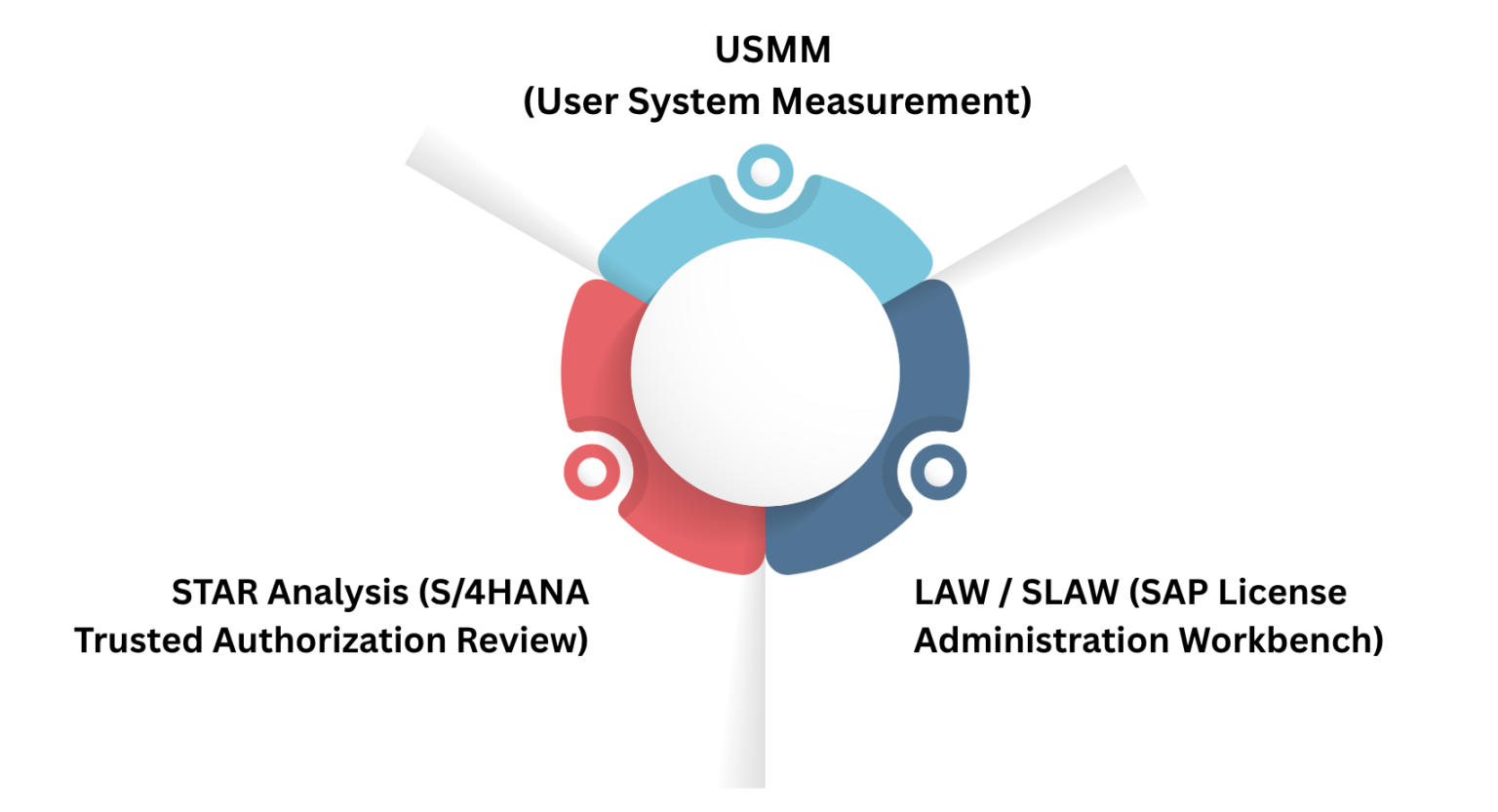
USMM, LAW/SLAW, and STAR - The three layers of SAP license measurement

While these are frequently referenced together, they serve distinct and non-interchangeable purposes. Understanding how they work together, and where optimization value truly resides, is essential for sustainable SAP license governance.

USMM: The Data Collection Layer

USMM is the starting point of SAP license measurement. Its responsibility is purely factual and technical. USMM captures named users, engines, and package usage. It classifies users based on technical attributes and is used to generate system-level measurement data.

USMM does not:

  • Interpret business relevance
  • Optimize license assignments
  • Assess authorization-driven over-classification

USMM answers only one question:

"What usage data exists in the system?"

LAW / SLAW: The Compliance and Consolidation Layer

LAW (and its successor SLAW/SLAW2) is the official SAP consolidation mechanism used during license measurement cycles.

LAW/SLAW consolidates USMM results across multiple SAP systems, applies contractual aggregation and measurement rules defined by SAP and produces the consolidated compliance position shared during audits.

LAW/SLAW does not:

  • Analyze authorizations
  • Identify optimization opportunities
  • Explain why and how licenses are consumed

"What is the consolidated compliance position?"

STAR Analysis: The Intelligence and Optimization Layer

STAR (S/4HANA Trusted Authorization Review) Analysis operates at a fundamentally different level. Rather than relying on technical user types alone, STAR:

  • Analyzes user authorizations and role content
  • Determines the minimum required license classification
  • Identifies over-licensed and misclassified users
  • Highlights systemic role wise licensing information

STAR answers the most critical question in SAP licensing:

"What license is actually required based on what users are allowed to do?"

This is where true optimization insight is created. All three are required, but only STAR produces actionable intelligence.

Key Takeaway:

SAP license measurement is a layered process:

  • USMM collects
  • LAW/SLAW consolidates
  • STAR explains and optimizes

Organizations that focus only on measurement remain reactive. Those that operationalize STAR move toward continuous license intelligence, lower audit exposure, and controlled SAP spend.

The most sustainable SAP license optimization strategy does not begin with buying more tools; it begins with fully using what SAP already provides.

Additional References:

Frequently Asked Questions

Is STAR Enough for my Licensing Optimization?

<p><strong>Technically YES!</strong>&nbsp;Many organizations over-invest in license saver solutions or tools before stabilizing fundamentals. In practice, STAR alone is often sufficient when:</p><ul><li>License exposure is driven by role and authorization sprawl</li><li>The objective is cost optimization, not just reporting</li><li>Audit readiness must be defensible and SAP-aligned</li><li>Internal teams can remediate roles and user assignments</li><li>There is a desire to reduce dependency on expensive tooling</li></ul><p>In these scenarios, STAR delivers the majority of optimization value by correcting license classification at its source.</p>

Do I need to procure additional licenses to utilize STAR analysis similar to third-party licensing tools?

<p><strong>No.</strong>&nbsp;You don't need any additional licenses and it can be installed directly in the existing SAP S/4HANA system (Check pre-requisites). Refer to SAP Note 3113382.</p><p><strong>NOTE:</strong>&nbsp;While STAR itself is not a single SAP Note, specific Notes are often referenced in community and internal SAP guides to support STAR-related activities. Additional references were provided at the bottom of the blog.</p>

How do I use this report?

Once the note is implemented, use the program&nbsp;<strong>SLIM_USER_CLF_HELP</strong>&nbsp;to help determine license classifications. You can refer to the note which details all the steps to deploy and utilize the solution.

When do you need external Tools?

<p>Specialized optimization tools can add value when scale and orchestration become limiting factors.</p><p>Tools are typically beneficial when:</p><ul><li>Managing very large or highly distributed SAP landscapes with large amount of users, contracts, and UDD agreements.</li><li>Executive dashboards and consolidated reporting are mandatory</li></ul><p>Even then, tools are most effective only when anchored to STAR-based intelligence. Automation amplifies insight; it does not replace it.</p>

Raghu Boddu

Raghu Boddu

SAP Security Architect & ERP Cybersecurity Authority

Raghu Boddu is a technology leader and cybersecurity professional specializing in SAP Security, GRC, data protection, and enterprise risk management. He is the author of SAP Press books on SAP Access Control, SAP Process Control, and SAP Identity Access Governance (IAG). Raghu focuses on building practical, automation-driven solutions that help organizations achieve secure, compliant, and audit-ready operations across SAP and cloud landscapes. He regularly shares independent insights and hands-on experience for practitioners and leaders navigating evolving cybersecurity and regulatory challenges.

What Actually Optimizes SAP Licenses: STAR, USMM, LAW/SLAW Explained | SAP Security Expert