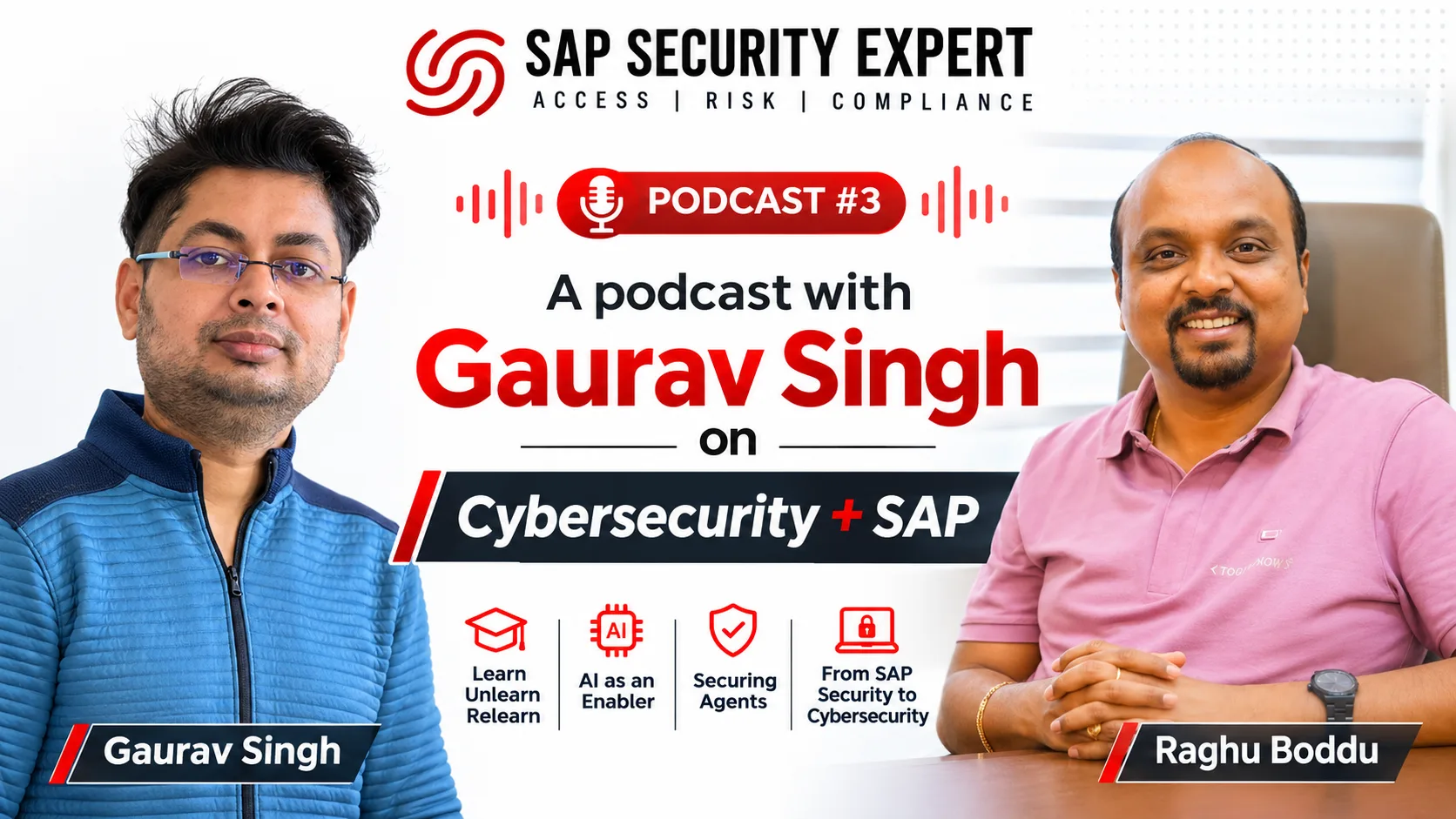
SAP Security Expert Conversations – Episode #003
Gaurav Singh × Raghu Boddu
- Guest: Gaurav Singh
- Host: Raghu Boddu
- Duration: Approximately 60 minutes
In This Episode
In this conversation, Gaurav Singh and Raghu Boddu explore how SAP security is evolving beyond traditional access control and GRC practices. They discuss the broader cybersecurity landscape, emerging threats, and the changing responsibilities of SAP security professionals.
Key topics covered include:
- Why SAP security professionals need to think beyond traditional SAP security and GRC
- Understanding the shared responsibility model and security considerations in RISE with SAP
- Building broader cybersecurity skills through certifications and continuous learning
- Applying Zero Trust principles and strengthening identity security
- Securing SAP BTP, service keys, integrations, and AI agents
- The role of SAP Enterprise Threat Detection and SIEM in threat monitoring
- Getting the foundations right through people, processes, and technology
- The evolving role of SAP Joule, embedded AI, and agentic AI in SAP security
- What Claude Mythos and Project Glasswing could mean for the future of AI security
- The skills SAP cybersecurity professionals will need to remain relevant by 2030
- Why collaboration, knowledge sharing, and community matter in the SAP security ecosystem
SAP security is evolving, and traditional access control and GRC practices alone are no longer enough to address today’s cybersecurity challenges. In this episode of SAP Security Expert Conversations, I speak with Gaurav Singh, co-author of Cybersecurity for SAP, about why SAP security professionals need to adopt a broader cybersecurity mindset. We explore the shared responsibility model in RISE with SAP, SAP BTP security, Zero Trust, identity management, AI agents, threat detection, and the changing SAP threat landscape. We also discuss the skills professionals need to stay relevant as SAP environments become increasingly connected, cloud-driven, and AI-enabled.
Watch the conversation below.
Listen to the podcast on the go
Read the transcript
Full conversation transcript
Raghu Boddu
Hey, Gaurav. Good morning.
Gaurav Singh
Good morning, Raghu.
Why SAP Security Professionals Need to Think Beyond Traditional SAP Security
Raghu Boddu
Gaurav, before we start today's podcast, there are a couple of things I want to discuss. One is the book on cybersecurity for SAP that you authored. It's a fantastic read. I've gone through it, and I really enjoyed the way you explain SAP cybersecurity. However, many SAP security professionals may not yet be familiar with the book or the broader topic.
That's the whole idea behind bringing you onto this podcast: to help our security professionals understand what cybersecurity means and what they need to consider when securing SAP environments going forward. Before we begin, could you briefly show the book to our audience and tell us a little about it?
Gaurav Singh
Before I do that, Raghu, thank you again for writing three amazing books and sending me a signed copy. I really appreciate it. I was trying to return the favour because I've been inspired by you and the work you've been doing over the years. I think everyone knows you. Thank you for everything you're doing for the SAP Security Expert community. I know you've been building several things there, and I really appreciate the effort. It takes a lot of time, energy and commitment.
It takes a lot of time, energy and effort. If it doesn't come from the heart, it's not easy. Your passion for this work really shows. Thank you for doing it, and thank you for having me on the podcast. I'm a podcast person, as you can tell. For anyone who hasn't seen or read this book, let me introduce it.
This is the book Cybersecurity for SAP, which I co-authored with JP and Mariano from Onapsis. I often refer to them as the original pioneers of cybersecurity for SAP. They recognised that we needed to go beyond the traditional things we associate with SAP security. If you ask an SAP security professional what they do, what would they say?
You will often hear: “I work on GRC, SOX and access control.” And we do those things well. Raghu, I think your books have also been instrumental in that space. We focus on GRC, identity, logging, auditing and segregation of duties (SoD). SAP has a strong ecosystem in these areas.
I don't want to compare SAP with every other application, but SAP has a mature GRC and access-control discipline. I used to describe myself as a Basis security and GRC professional. Later, I added cybersecurity to that description. I believe cybersecurity starts with a mindset.
We need to go beyond what we traditionally call SAP security or SAP GRC security and adopt a more holistic cybersecurity perspective, especially in today's environment. I could go on, as you can tell, because this is a topic I'm passionate about.
The idea for the book came from seeing two different worlds. There is the SAP security and GRC community, which we know well and work in every day. Then there is the information security and cybersecurity community: the CISO's organisation and the broader enterpRISE security function. If you ask a CISO, “How do we secure SAP?”, you may hear, “I don't know. SAP is a black box to me.”
They may know that SAP teams work on GRC, audits and SOX compliance, and may assume that everything is therefore under control. That can create a false sense of security. GRC and identity and access management (IAM) are important domains, but they are only parts of the broader cybersecurity discipline.
Cybersecurity is multi-layered. It includes incident response, security operations centres (SOCs), vulnerability management, threat monitoring, business continuity and disaster recovery (BCDR), cloud security and, increasingly, AI security.
That is where the idea for the book came from: how do we bring these two worlds together?
The first step is to build the right mindset and use an appropriate framework, whether that is a recognised cybersecurity framework or SAP's own security and operations guidance. We need to bring these perspectives together. One thing I have learned is that nobody is going to come to the SAP security team and automatically teach us cybersecurity. The broader cybersecurity teams are busy with their own priorities, and they may not understand the SAP world as well as we do.
It may be easier for SAP security and GRC professionals to broaden their responsibilities and take on a cybersecurity mindset. It is up to us to learn and adapt. One lesson I have taken from conferences and conversations is: learn, unlearn and relearn. We already know SAP. Now we need to understand how information security professionals and CISOs think.
That is the idea behind the book: to bring these two disciplines together and provide a starting point for anyone beginning a journey into cybersecurity for SAP.
Raghu Boddu
The purpose of bringing the book into this conversation is not to sell it. It is to make the point that cybersecurity goes beyond traditional SAP security. For years, we have focused on authorisation objects, restrictions, user management and role assignments. Those are important parts of application security.
But cybersecurity is much broader. Given the scale and nature of the attacks taking place, SAP security professionals need to understand the wider cybersecurity landscape. I hope listeners will consider reading your book, build a stronger understanding of cybersecurity and take the next step in their careers.
Gaurav Singh
I would recommend reading the GRC book as well. Nobody has all the answers, so we need a multidimensional approach. Continue doing what you do best in GRC, because GRC and identity remain important in the emerging agentic and autonomous enterpRISE. At the same time, expand your knowledge, understand the shared responsibility model and recognise which security responsibilities remain with you as a customer.
Go beyond the traditional GRC and SAP security practices we already know. Understand the responsibilities that apply across the different layers of your SAP environment.
SAP RISE and the Shared Responsibility Model: Who Owns Security?
Raghu Boddu
Gaurav, I want to bring up a recent discussion I had with a customer.
I was explaining the importance of cybersecurity, and the customer said, “We already have enough firewalls.” They were using SAP RISE and felt that cybersecurity was no longer a shared responsibility - that SAP now owned the entire security function. What are your thoughts on that?
Gaurav Singh
I briefly mentioned the shared responsibility model, and SAP is increasingly emphasising it. There is definitely a false sense of security in our industry. When organisations move to RISE with SAP, particularly at the C-suite level, non-technical stakeholders may assume that the service is equivalent to SaaS.
Some SAP services are SaaS, but RISE with SAP, including the private cloud edition, is not simply a SaaS model. We need to do a better job of explaining this to executives, owners and other stakeholders.
SAP publishes a Roles and Responsibilities document. It is comprehensive, but it is also lengthy - more than 60 pages. People may not read it, and they may assume that once they move to RISE, SAP takes care of everything. SAP is responsible for the layers defined in the agreement and service model; that does not mean it assumes every customer responsibility.
The shared responsibility model identifies the application and infrastructure layers and clarifies which responsibilities remain with the customer. When moving to RISE, review your policies and standards, perform a gap assessment and determine whether the required controls are in place.
Some controls may be covered by SAP's SOC 2 assurance or by SAP's responsibilities for infrastructure and operating-system maintenance. However, customers still need to raise service requests, coordinate downtime and manage the activities assigned to them. Application-layer vulnerabilities may also require timely customer action.
The threat landscape has changed. SAP environments are more connected and increasingly cloud-based; they no longer sit only behind a corporate firewall. The attack surface now includes endpoints, SAP BTP, business AI capabilities and the Integration Suite.
You cannot outsource all security to a cloud provider. As a customer, you remain responsible for the security and governance of your own data and applications. You are transferring some responsibilities to SAP as your cloud service provider, but you need to understand exactly which layers SAP operates and which remain yours.
Understanding the shared responsibility model and the RACI matrix is essential. RISE can bring security benefits through SAP's scale, expertise and tooling, but it does not transfer every security responsibility from the customer to SAP.
There's still somebody's cloud Either you host it on your side or your SAP is hosting for you. They have economy of scale, they have a lot of different tools. And they are doing hardening, very well than what you can do. So it does bring a lot of security benefits, but it doesn't transfer every security responsibility from your side to them.
Some customers are unaware that the Roles and Responsibilities document exists. I have guided customers to the publicly available document so they can understand which responsibilities belong to SAP and which remain with them.
For listeners who have not reviewed it, I strongly recommend finding the SAP Roles and Responsibilities document and understanding the division of responsibilities. Security remains a joint responsibility. Moving to SAP cloud - whether public or private - does not mean that SAP owns 100% of your cybersecurity responsibilities.
And that is where they understood, like, what all responsibilities lies with the customer and what SAP owns, So I really see a gap. So for our listeners who actually don't know that roles and responsibilities document is available, I suggest them to go through Google for it and then find out, understand what lies with customer and what lies with SAP.
If you are already on the RISE journey or planning to move, speak with your SAP account executive. SAP also has cybersecurity advisory specialists who can help explain the model to customers and executives. These experts should be involved early, but they are not always included in the discussions.
I recently attended an enterpRISE architecture conference where one session discussed the “empty chair” - the stakeholder who should be part of the conversation but is missing. I think the same applies to cybersecurity professionals. They are not always included when S/4HANA transformation or RISE decisions are being made.
Cybersecurity professionals need to be at the table and ask the right questions. Use the Roles and Responsibilities document, and use AI tools to help derive metrics, trackers and draft assessments against your policies and standards. Validate the outputs before relying on them.
Cybersecurity professionals need to be involved in those decisions. They should be able to ask questions during S/4HANA and RISE discussions, rather than being brought in after the decisions have been made.
Use the Roles and Responsibilities document as an input. You can also use an LLM to help draft metrics, trackers and a RACI matrix, then assess the results against your own policies and standards.
Building Cybersecurity Skills: Certifications, Cloud Security and the Bigger Picture
Raghu Boddu
It is becoming easier to derive policies and draft a RACI matrix with the LLMs available today. Gaurav, I want to explore another dimension with you. You have worked in both security and SAP Basis, as well as other technical areas of SAP. For many professionals, security still means segregation-of-duties analysis.
Security is often reduced to maintaining roles and authorisations. For someone new to this field - or someone who thinks SAP security is only about user and role management - what is the one recommendation you would give them?
Gaurav Singh
I'm a big believer in starting with why, what and how. We explain in our book why cybersecurity for SAP matters and what professionals can do about it. But if I had to give one recommendation, it would be this: pursue a cybersecurity certification, not only an SAP security certification.
SAP offers several certifications, but many focus on GRC and SAP-specific topics. I'm a big fan of ISC2. Completing the CISSP and CCSP certifications was a pivotal moment for me. I did not pass the CCSP on my first attempt, but I passed the CISSP on the first attempt. CISSP is widely regarded as a leading cybersecurity certification, although it involves a significant amount of theory.
The important thing is to understand the fundamentals, including the CIA triad, and learn the language used by information security and enterpRISE security teams.
We speak in SAP terms - T-codes, ABAP, Fiori and GTS - and use acronyms that may be unfamiliar to cybersecurity professionals. We need to understand their language too: network segmentation, VPCs, VNets and cloud security concepts.
For someone starting their career, I would recommend ISC2's entry-level Certified in Cybersecurity (CC) certification. ISC2 has previously run campaigns offering it at no cost; check its current programme details. It provides a useful introduction to cybersecurity fundamentals.
Learning must continue. I'm also trying to learn about AI and tools such as Joule Studio. SAP security professionals need to understand not only SAP, but also enterpRISE security, cybersecurity and cloud security. If you have 10, 15 or 20 years of experience, consider pursuing CISSP.
You could also consider CCSP, which focuses on cloud security. These certifications can help you think like enterpRISE cybersecurity professionals and communicate with them in a common language. We understand SAP; we should also make the effort to understand the broader security landscape.
The more you understand cybersecurity, the stronger you will become as a security professional. I am not suggesting that people collect certifications just to add them to LinkedIn. Focus on learning, and start with one or two relevant certifications.
Raghu Boddu
Learning is more important than certification. A certification can certainly add value, but learning is more relevant and important in today's environment.
Gaurav Singh
Preparing for an exam creates a deadline and a sense of commitment. If you start a course without a target, you may not finish it. I remember having to retake the CCSP after I failed the first attempt. That experience taught me perseverance
Raghu Boddu
Cause of that. Okay.
Gaurav Singh
Start with one or two certifications. Don't feel pressured to add ten different certifications to your LinkedIn profile. If you enjoy learning and want to pursue more, that's your choice. But begin with one or two that build a solid foundation.
Raghu Boddu
I hope you looked at my LinkedIn profile and then looked all the certifications next to my name and then commenting this.
Gaurav Singh
I'm not saying that certifications are only for adding credentials to your profile. What matters is whether you have genuinely learned the subject. I've met people with many AI certifications who still struggle to hold a meaningful conversation about AI. I am also learning, and I don't yet understand every aspect of it.
Raghu, your certifications reflect your commitment to learning, and I'm all for that. But consider your time, work and family commitments. If you had to choose one, consider ISC2 CC, CISSP if you meet the eligibility requirements, or CCSP. You could also explore a cloud security certification from AWS or Microsoft Azure if cloud security is your focus.
AI also runs on cloud infrastructure, whether SaaS, PaaS or IaaS. That would be my recommendation, although I know I've given a long answer to a short question, Raghu.
Raghu Boddu
I often explain it this way: imagine that your home has seven doors. If you secure only the last door, which represents SAP, it doesn't make you secure. You also need to protect the other six doors, including the infrastructure, database and other layers.
You cannot put ten locks on the last door and assume the entire house is secure while the other six doors remain open. That is why learning and broader security knowledge matter: you need to understand how to secure every layer, not just SAP application access.
Gaurav Singh
I completely agree. Your seven-door analogy explains the idea of layered security very well. It also reminds me of the OSI model, although I may be mixing the analogy with the network layers. I like the way you explained it, Raghu.
This podcast is also part of that learning process. Bring in people with different areas of expertise - someone who works with AWS, someone who understands networking and others who specialise in different layers. Network security is not my strongest area, but I try to understand enough to speak the same language.
If someone talks about subnetting, availability zones, VPCs and VNets, you need to understand those concepts. A cloud certification or the CCSP can help build that knowledge.
Zero Trust, Identity and the Security Challenges of the Agentic EnterpRISE
Raghu Boddu
While we're on this topic, I also want to discuss Zero Trust and the IAM solutions emerging alongside cloud integration. We hear about SAP Cloud Identity Services, IAS, IPS, PAM and other technologies. Zero Trust is gaining momentum. What is your view, especially for professionals working in SAP security and GRC?
Do you think learning these newer technologies would add value? What would you recommend?
Gaurav Singh
I check the SAP architecture website regularly, and new architectures and guidance keep appearing. At SAP TechEd, we heard about the enterprise AI gateway. I'm still working through what that means. I also like SAP's direction towards the autonomous enterpRISE, which was discussed at SAP Sapphire and is now moving into generally available capabilities.
The governance layer is not an afterthought; it is built into the architecture. SAP is also discussing data contexts and a knowledge graph. We use different names for identity services and capabilities, and the terminology continues to evolve.
I believe the official name is SAP Cloud Identity Services. People may use different abbreviations, so it is worth checking the current SAP product terminology before publication.
Raghu Boddu
It is serious.
Gaurav Singh
And then there's IAG, there's a GRC which you are the guru and the whole new GRC on HANA and IAG. So it's a new word for all of us.
But which the word which we excel And I love the way SAP is pushing for everything that CIS has to be part of your SSO It's you cannot just simply go to my ENTRA or whatever If you have success factor for Joule to work, and everything there is a if the whole architecture, I don't know if you can share here or maybe later, the whole architecture diagram which we see for autonomous enterpRISE, the whole AGENTIC, A2A, whatever you call MCP.
So there are two buckets which are really critical now, at least the bucket which customer would be owning it. That is the first is the integration suite, which is going to how your MCP gateway, your enterpRISE AI agent gateway, whatever we're calling it. I think yes called enterpRISE. I think the agent gateway is different,.
But and then there is a where we comes into play The whole CIS, as the identity, which so you're going to become that key to the castle And even the agent has to have its own identity, it has to still respect the authorations and things. So don't just assume, don't just give like a sap all or broader access than agent should. I would even rather go conservative.
I was thinking maybe how we should build our roles just for the agentic world. Maybe I don't want to I don't want to say like build like a for one tile or one T code a role. But maybe that's where the path we are like we have to go granular now. We have to only fig enforce the least privileges now for the agent. The users, okay, based on the job and functions and things like that.
But just because this bot and you have to s I don't think I have the answer, Raghu, but I f I still love the part. The CIS is WHERE and the whole architecture. So we own a lot of responsibility and I always keep saying that word. With great power comes great responsibility. So it's on you listening to this podcast.
You hold the key to the castle for the new agentic AI world, which is coming, which is already here for all of us.
Connecting SAP to AI Agents and LLMs: Innovation Without Compromising Security
Raghu Boddu
And in fact, one key point that I want to discuss here, Gaurav, a lot of people I see who were doing VIBE coding, they came out and they started their own saying that, OK, we'll connect your SAP to Claude. We'll connect your SAP to OpenAI, LLMs. Then they are promising that they automate many things What I understand here is the thin lane, which is cybersecurity. It even opens your SAP system to the outside world.
And it is even giving all your critical business data to the LLM if it is not properly configured or handled. So how do this transition or how do this adoption is going to impact enterpRISEs when they are not properly configured?
Gaurav Singh
I think you've brought up a very good point because now everybody wants agent And I feel like we cannot be that blocker. We have to be enabler, because security we always say we are not in business of security, business of securing the business So the a agents as it happened with the cloud before, like everybody was pushing back to the cloud.
Nobody's going to move to cloud, this is all and but now every the cloud is by default. And also if you like, it brings a lot of security features too. So same for agents. I think the agents and AI is going to be here. But I love the way SAP is pushing. Like you have to do this way. They have this new API policy. You simply expose your SAP to in a random agent.
Even if you use Copilot, it must go via that A2A protocol, going to my SAP layer of autonomous enterpRISE in the agent gateway and the enterpRISE AI gateway. But I think I So this conference which I was referring to, so I was I had some we had some panel around similar cybersecurity topic. And I thought like how what I can maybe and I try to bring something in everything I do. I had my Claude. I am a big Claude again.
I love Claude and I'm a big fan of Claude and there are other on a personal side. Like I keep learning every day, I just consume all the token I have, just keep playing with it. I connected my Claude so I connected my Claude to my BTP trial account.
Raghu Boddu
Same with everyone.
Gaurav Singh
And then I ask deleting a sub account. Can delete a sub account for me Or maybe a service within a sub account So it's and it did. So it would ask you, okay, okay, we have this sub account, we have maybe CIS tenant, we have, and again, this is a trial account But again, going back to the same, like with great power comes great responsibility. So we need to limit And again, I try to be the AWS security guy.
I try to bring the whatever AWS does it and there are other things I feel. And again, I'm a big fan of BTP, but I feel like there's still some maturity, at least on the security and governance side and that on that layer as well. So it's not just S/4, it's not just S SAP ECC anymore. Because we're pushing with towards clean core, low code, no code, pro code, whatever.
So all that development is happening on this side of the world, which is so new for us as a community If I ask who's a BTP admin, you probably say the basis guy or a security guy And do even like I can have my Gmail account created there and I can log in. I don't need that layer. So in the old SAP world you have to have your AD account and it's within firewall.
You cannot access SAP outside, but BTP is all available to the internet And as long as and you don't think too much, you don't put that security by design, you have to enforce no default IDP. It has to go to my enterpRISE SSO. It has to have MFA. Because if I'm a sub-account admin, or if I'm a global account admin, the risk is huge. And it can. So my cloud, my cloud code or Claude desktop, it did.
And even though I have integration suite there and I have whatever. I'm a bad guy. I get your whatever credentials. You don't have MFA. I'm into your BTP.
Raghu Boddu
What in case if you just delete it?
Gaurav Singh
I do whatever have to do and then I delete the instance, the log and no, there's audit logging is now baked in now, but that also is 60 days or 90 days and maybe it's not going getting fitting into your SIEM and all But if the instance is gone, you're gone. And now SAP, I think recently introduced, you can recover it in seven days, but it's still not stopping you to delete it.
I actually had a submitted feature request, the first exposure I had with BTP. Let's have some MFA on delete or things like that, which I feel like is coming soon. But it's all new territory, which we are not being trained, we were not ready. And the service keys, the whole NHI You just share that on some chat or somewhere. You save on your local machine. It's just going to be living there ever.
Anyone getting into your laptop, they have the service keys, is that entry to your SAP ecosystem So I think we need to be very careful. Don't connect to your Claude, just random AI agents and give your credentials.
Raghu Boddu
Landscape. Yes.
Gaurav Singh
Follow the approved SAP reference architecture path, follow the SAP's new API policy, and make your basis friends, make your cyber friends, make your age all this AI like your friends. Like you should be talking to them a lot now. Understand what they are doing. They have PAM, maybe they have all these different tools. How do I get the inventory of my agents? LeanIX, I think it has now that whole governance baked in now.
So if and I think I've been told if you are going on that S/4 RISE contract. LeanIX as a free. SAP is doing a lot of great job now to putting that governance. It's not an afterthought. So bringing those things. If you are already not doing it, this is the time to have that governance before it's too late.
Native SAP Security Tools and Services: UCON, SOS, RAL and Secure Operations
Raghu Boddu
You were speaking about LeanIX Lot of customers don't even know about this. I'm probably taking a step back and then speaking about what is the native application, is unified connectivity. UCON. Even today, when I talk to customers, I'm pretty sure 8 of 10 customers doesn't know what is unified connectivity. They say, what is this? Do I need to pay for this? And I always tell them that, this is a native application.
You don't have to pay. You just need to configure. This is part of your offering. Right. There are many applications like this. Like I was also speaking to one customer about security optimization service, right. SOS, which really scans your system and tells what is missing in your application today. Right. What all the probably, key areas that you have to secure, which has got probably in red today. So that is very important.
Understand what offerings can be utilized. Understand how, rather than going for a third party application or building your own on AI models, it is always better you understand what SAP is already offering, and then you bring that.
Gaurav Singh
I think you brought up I think you mentioned about that in the podcast when you came, I think in my show. I think the UCON, the RAL, the SOS service you said, the security baseline document, which is amazing document The whole secure operation map So SAP has done an amazing job. But I feel like in now the solution manager now, Cloud ALM has this whole security and then LeanIX.
I think there's so much Being offered by SAP, which you already probably own it today. But I don't think we do a good job. maybe it's in is in our in our in probably on us for as a as a community. We just focus on just SOD and SOX and GRC access control. And we don't even think about this early watch report and it just somebody just getting the reports and the SOS service.
And it is offered you as a as a the moment you own the l and the whatever contract and license. and I think SAP is doing a good job on the RISE. I think they're enabling UCon by default, if I'm not wrong. They're hardening the system. You have to configure it. You have to configure it. That's on you as a customer, as a share responsibility model to configure.
So they will enable for you, but you still have to configure it, which nobody is going to do that But at least they are hardening.
Raghu Boddu
The UCON is enabled, but then you need to configure.
Gaurav Singh
And the secure b s for secure baseline. So they're doing a good job, but there's still some part which you as a customer own and they clearly explain it, but it's not part of the whole S/4 transformation. You just want to just go around and just build it and I don't know.
I think it's probably we should take it in our an as, Raghur, we as a SAP security community and ensure we have some this is must to have, this is free, it doesn't need extra license. We always complain about license We nobody gives budget and all, but these are things all It's all free It's maybe just a matter of us to understand and know how to do it, how to configure it.
Turning Experience into Expertise: Continuous Learning in SAP Security
Raghu Boddu
In fact, I want to speak about two articles that I've posted on SAP Security Expert. One speaks about what all tools and applications you get by default with your SAP contract that you can enable and what is the advantage of that. If you haven't that particular article, I suggest you also go give comment, give your recommendation or if you find something is missing today, I want to I want you to comment in that article.
At the same time, I recently published one more article which says experience is not equal to expertise. You might carry experience. You might be doing security GRC work for the last 10, 15 years. But then if you don't know about these new offerings that are coming from SAP, or you don't know how the threat landscape is moving forward and then If you are not at par with that, it remains as an experience, not as an expertise.
Right. So these two articles, I really want you to spend some time Gaurav and then, give your comments on them. Also share it to your network so that I, if one person picks it up and then learns the new topics, that is that SOLVES my whole purpose of publishing these articles.
Gaurav Singh
No, I think I always say like even for the book People ask why do you write books? And I always say like I don't know. I first like i have follow like write the book you want to read.
And then also like if one person can get benefit and I in the conference when I go and somebody would come, so one person he was a basis guy and he came and he said, I read your book and then I was able to talk to my leadership about cybersecurity. I think highly again big fan of your content and blog. I will definitely go and look. Now also I just want to give one story. Greenfield, Bluefield, whatever.
I know there was an amazing blog and which I when I was searching, I found it and shared it. Then I told my teammates, I know this guy. So it was Raghu, so written by Mr. Raghu on a community blog. I think thanks for all the good work, all the content and everything you create, Raghu. I think you have been like the OG, in our community. And again, you're rebuilding and I love the way you're building it.
And I saw some new updates, some we will provide some access also, some lab, which is also good. So any way I can be part of it, I would love to. I know I have committed more than more than I can. And even this podcast was long due for us. I know we wanted to be first, but I apologize for all the delay. But please I think please keep doing what you're doing and amazing work. And I'm a small guy, but I will I try to do my part if I can. And I apologize for any delay. Any delay if I had.
Raghu Boddu
Definitely. It's one person cannot build great things. Definitely. It's all, when people join hands So the whole idea of doing these meetups is also the, that is the purpose of me doing these meetups. Okay. So two new things which are coming up. One is the test labs thing where people can go test what their skill level is. It's MCQs that you get.
Your answer, then it will also tell, a complete explanation on what it is, why, what is wrong, and all those stuff. I want to try with every question that I'm asking, enable the person to understand about that topic, and then, really learn.
So the whole idea of SAP Security EXPERT is learning, give back to our community So one space where I really need your help is in building up something on SAP cybersecurity or cybersecurity for SAP So I'll reach out to you separately on that and probably let's work. It's really great and thanks for, coming up and then offering your help in building this community, making it a better place for people.
Gaurav Singh
I don't think I know all the answers, Raghu, but I'm happy to do and play my part.
Common SAP Security Mistakes: Why Security Must Start at the Design Stage
Raghu Boddu
Good. I want to get the discussion back to the topic. So probably, since Gaurav, you are both security guy and then cybersecurity guy, what are the most common security mistakes that many enterpRISEs are not caring about in SAP landscapes today?
Gaurav Singh
I think as you briefly touched and we talked about it already I think not thinking about security at the very beginning of the transformation. I think security, we always keep saying security by design, the shift left and other things. But I feel like we need to do a better job. Not just like I'm just calling it us as a professional.
I think it's there are different kinds of stakeholders there And as I keep saying, like Nobody's coming It's going to be you. So you need to first empower, understand, and also get that get that seat on that table and create that relationship so that they are reaching out to you. So you and I always keep saying, I mentioned that in that conference also. I may not be on every room But have friends in a different team.
I always have like one friend in basis. I have like, I don't know, like there's like We just share passionately and things. And so I know they have my back. And in my own team And I feel like that's how it should be. If you're not and if it i saw some posts yesterday, or maybe they're on LinkedIn, somebody created their own SAP trial system and he's like a some finance FICO guy.
And he was saying to basis guy or security, I said no, we are security. Like, be nice. They don't and he was saying like in a good humoric way I think don't be that guy like who's like a Saying no. I think we are not in like you have to enable them the again you have to enable business but in a secure way. So find out the right way, create the relationship. Because this AI word, I think nobody knows what it is.
It's changing every day. And if you don't have that team, or that whole collaboration and also I think some of my mentors said one day and I think a long time back, he told me a story about that tortoise and that And that whole story Okay, one was he slept and that other guy won and other things Bunny and tortoise So I think he told me three different iterations.
The third one he said in the today's word and he asked me who would win. So he I think the first example was okay, tortoise, okay, but next time Bunny was he was aware. He knew if I sleep, this guy is going to win. So second time, because he learned As long as you learn and learn from your mistakes, and second time bunny's going to win.
Third time, and I think he was again I'm not remembering everything, but the third time he said, it's the who's going to work together. So maybe there is a water. So you change the landscape. Maybe instead of a land is a river or something. So they have to collaborate now. It's not tortoise versus bunny. They all need to come together.
Maybe for the river, the bunny can sit on the tortoise top and maybe so whose ever is working as a team, they're going to win. And if you're not working with bassist friends, you're a developer and BTP, I think you're going to and so bring in that mindset. Start early. Don't assume things. I think ask those questions, connect with your SAP cybersecurity.
There's a I know I have a friend called Rob who leads the North America Cybersecurity Advisory, and SAP has all these experts and leaders. They have a whole advisory practice just to be there in that whole pre contract phase. So reach out, then you get an EA. Post you sign the contracts use those opportunity.
The things you said there is there's so much resources. and if you're not learning, I don't think we would be ready to a long answer to your to your question, Raghu, but I there's no one answer. There's.
Raghu Boddu
No security is not one man's task or activity It is always a collective work. And then when you deliver it as a team, you secure the system much better than what you can individually secure it.
Gaurav Singh
And you would earn it I think there's something called like earn currency. So if you help somebody and then empower them, next time when it comes, they're going to reach out to you and say maybe or that's what h it w it's not going to happen day one. But build the relationship with the different team with stakeholders. Start ask those right questions and use AI. AI would let you and it will guide you.
It's not like we always keep saying AI good or bad. But I feel like if you use AI and somebody also said AI use AI as an input. Not as a output. So use as a input and then if you just and we are using as an output. We're putting all this on LinkedIn and putting everything on LinkedIn. People will know And that defeats the purpose. Use as an input and then bring your curiosity, your mindset, and then the questions.
And be the team person. I think the team being a team person probably is the better, answer, Raghu.
The Modern SAP Attack Surface: Identity, Service Keys, BTP and AI Agents
Raghu Boddu
And put that. Yes. Is always working. Correct. I think probably one last question that I want to ask before I get into the next segment. How does the probably know the SAP specific attack look like today, you from a cybersecurity side of it? Today, I might say that, OK, I don't have available, DDIC available, or I don't have SAP_ALL or SAP_NEW assigned to any of the users.
So these are typical IT general controls that you validate and then ensure you are secured. But as I said, cyber threat landscape is beyond this. It looks beyond this. So what is the realistic SAP specific attack chain that you often see today? And what would be the business impact of it.
My co-author JP may be better placed to answer this, but I'll try. I'm not claiming to be an expert in this area. I think the human element is important. The next attack may not involve someone trying to activate the SAP* user by changing a parameter. It may involve compromising the credentials of an SAP administrator, security professional, Basis administrator or BTP administrator.
Maybe my co-author, JP, would be the right person to answer it, but I will try. I will try. I'm not an expert here, Raghu. But I think to me it's more on the human side. I feel like it's not going to be a bad guy trying to get that SAP* user activated by changing the parameter or doing whatever we have to do. I think it's going to be me as a SAP admin, SAP security, a Basis admin, or even BTP admin.
An attacker could steal credentials or compromise an administrator's laptop through social engineering or phishing. Misconfiguration is another risk. I see SAP BTP as an important emerging threat vector. Even a small leak of a service key could be enough to create a serious exposure.
The Integration Suite is particularly important. I can mention a book project here, if you allow me: our next book is expected to focus on Integration Suite security. It is like the nervous system of the environment and can become a critical path into connected systems.
Raghu Boddu
Is gone. Yes. Fantastic.
Gaurav Singh
If you don't have strong governance around service keys, non-human identities (NHIs) and privileged access management (PAM), those areas could become entry points for attackers. An attack may involve a combination of techniques rather than a single zero-day vulnerability. An attacker may gain access through a service key and then exploit a weakness in a connected SAP backend system. Identity is often the starting point.
Identity is becoming a critical security perimeter. With Zero Trust, organisations must rely on enterpRISE identity controls as well as SAP controls. That includes controls around Active Directory and other identity platforms, even when SAP security teams do not directly own those environments.
Make sure your identity controls and policies are enabled, including multifactor authentication (MFA), particularly for external users. The increased use of SaaS applications and publicly accessible endpoint URLs expands the attack surface. We need to be prepared for those risks.
AI agents introduce another potential attack vector. I remember a story about an agent being manipulated through prompt injection and taking an unintended action involving the sale of a car or the application of a discount.
There is a blog series about this on the SAP Community. As organisations build more agents, agent security will become increasingly important. The pressure to adopt AI is coming from the top, but the security implications need to be considered at the same time.
SAP is developing its agentic AI capabilities and incorporating governance into the architecture. However, governance within an SAP product does not automatically solve every security challenge in the wider enterpRISE. Organisations still need to secure their own SAP environments, and identity will be central to that effort.
I don't claim to know every detail, but I expect attacks to involve a combination of human, identity and configuration weaknesses. The fundamentals remain important: strong identity controls, a clear security perimeter, least privilege and appropriate restrictions. In BTP, for example, not everyone should have subaccount administrator access.
Create appropriate custom roles, restrict administrative privileges and ensure that only authoRISEd administrators can perform administrative tasks, create service keys or open Cloud Foundry spaces.
Raghu Boddu
Thank you. Now good you covered it well I think.
Gaurav Singh
Go in that layer and.
Raghu Boddu
You may need additional controls. Revisit your controls and operating procedures, then fine-tune them. It is easy to say that you have moved to BTP or SAP private or public cloud. But if your security practices remain the same as they were 15 years ago, the transformation has not delivered the security improvement you need.
Gaurav Singh
Auditors may not yet understand these emerging risks. As a security professional, you need to explain the new threat vectors and help define appropriate controls. The controls that worked for traditional IT general controls may not be sufficient for today's connected, cloud-based and AI-enabled SAP environments.
Raghu Boddu
I have heard the same set of control discussions for the last 15 or 20 years, with very few new IT general or application controls being introduced. I think you have answered the question well, Gaurav. You may not have claimed to know every detail, but this is the perspective I was looking for.
SAP Enterprise Threat Detection and SIEM: When Do You Need Them?
Raghu Boddu
In this next segment, I'll ask you about a few products and capabilities. You can give a one-sentence answer, a two-sentence answer or one of your favourite long answers.
Let's start with SAP Enterprise Threat Detection. What's your view of it?
Gaurav Singh
I try to approach security from a process perspective. You should not buy a tool simply for the sake of having a tool. Start with the control you are trying to achieve and the problem you need to solve.
Start with people, process and technology. Assess your landscape: are you on premises, moving to RISE, or going through an S/4HANA transformation? Understand where you may lose visibility across the different layers.
If you are moving to RISE or going through an S/4HANA transformation, SAP Enterprise Threat Detection (ETD) is worth evaluating. It provides SAP-focused threat detection capabilities. I would not describe it as a replacement for an enterpRISE SIEM; consider how it fits into your wider monitoring architecture.
Raghu Boddu
It also has other features and capabilities that can add value. Is a SIEM a nice-to-have or a mandatory component for SAP security?
Gaurav Singh
Most enterpRISEs already have a SIEM within the CISO organisation. The question is whether SAP logs and relevant security telemetry are being sent to it. This is where ETD can fit into the picture: it can provide SAP-focused monitoring and telemetry that can then be integrated with the entererise SIEM.
I would not call monitoring optional, but the right solution depends on cost, return on investment and whether you have a team that can operate it. You can buy all the tools available, but if nobody is monitoring them, they become just tools that generate alerts and may create a false sense of security.
Raghu Boddu
Otherwise, it becomes an expensive paperweight.
Gaurav Singh
Don't buy a tool just to tick a box. Think about the three elements: people, process and technology. Define the outcome or control you want to achieve, and make sure you have the resources to operate the solution. In the future, agents may help with some of these activities.
For example, I would like an agent to review newly published vulnerabilities and identify the SAP security notes that apply to our landscape. That is something I would like to see automated. I am not a developer, but I am interested in learning more through Joule Studio.
The agent could create a ServiceNow ticket, notify the Basis team through Microsoft Teams and help coordinate the required action. It could also connect to ETD, Onapsis or another monitoring platform to gather the relevant information. I have seen discussion of similar agent capabilities for SAP Cloud ALM, and I look forward to testing them.
But the process must come first. Without a process, a tool is just a tool. We also need to account for people and resources. ETD can feed relevant telemetry into a SIEM and help empower the SOC team with a more complete picture of an incident or attack.
If the investment makes sense for your organisation, evaluate ETD alongside other SAP security and monitoring capabilities, including SAP's log management and cloud application security offerings. Don't limit the assessment to one tool. Look at the overall landscape, assess your requirements and decide what you actually need.
People, Process and Technology: Getting the Foundations Right
Raghu Boddu
We have already discussed LeanIX and LogServ. Before moving to the next questions, I want to share what I often tell customers and peers: security should start with people, then process, and then technology. You can introduce AI or any platform you want, but the foundations must come first.
Platform adoption should come last. First, put the right people and processes in place. Then decide which platform to adopt and how to use it effectively. Investing in technology is easy; investing the time and effort required to scale it is the real challenge. You made a good point there, Gaurav. Now I want to ask about two terms we hear often: embedded AI and Joule.
Embedded AI and SAP Joule: What Comes Next for SAP Security?
Gaurav Singh
Embedded AI and Joule. I would start by saying that I don't know everything. I'm still learning.
Raghu Boddu
It can be one line answer. You can simply say, I love it. This is what is happening and this is what we are doing. Should be enough.
Gaurav Singh
Work in progress.
Raghu Boddu
You're adapting something on both of these and we can see some stories around this space very soon.
Gaurav Singh
SAP has also changed its approach. Joule is evolving, and Joule Studio 2.0 is part of that direction. It is still a work in progress, in my view.
I'm enthusiastic about the direction and the governance approach, but I also want to be a user and builder. If security professionals are not experimenting with these tools and using them themselves, we are not doing our jobs properly. I cannot wait to build agents and explore how they can help answer the questions users bring to SAP GRC teams.
We are moving towards a world where agents will support many activities and help us serve end users. I often say that when we go live, the security team is seen as the blocker. We need to change that perception and become enablers.
Claude Mythos, Project Glasswing and the Future of AI Security
Raghu Boddu
What's your take on Claude Mythos? Have you used it, or are you looking to build something with it?
Gaurav Singh
I don't think Mythos is available to individuals. I've been exploring other models and features, but I am particularly interested in the research around Mythos and Project Glasswing (a cybersecurity initiative launched by Anthropic on April 7, 2026, to find and fix vulnerabilities in critical software using its Claude Mythos Preview AI model). I am optimistic about the direction, although my comments are based on personal interest rather than a formal assessment.
Raghu Boddu
That's how I understand. not selling.
Gaurav Singh
I think this area is moving quickly. I participated in an ISC2 workshop focused on developing an AI certification. At the time of the conversation, ISC2 was expected to launch a beta exam in December. The aim is to establish appropriate guardrails before making the certification available more broadly.
We still need to make sure that security is built in by design. We should pause before simply enabling a capability and connecting it to SAP. I may not have given you a one-line answer, but the message is: great power comes with great responsibility.
Raghu Boddu
And what about Hugging Face and rogue agents?
Gaurav Singh
We need to learn from these developments before similar challenges reach our own environments.
SAP Cybersecurity in 2030: The Skills Professionals Will Need
Raghu Boddu
Let's close with one final question, Gaurav. Imagine SAP cybersecurity in 2030. What is the one recommendation you would give the SAP security community?
Gaurav Singh
First, I'm going to borrow some of the questions you're asking for my own podcast. I like the format. I tried it before but wasn't consistent. If you're happy for me to do so, Raghu, I'd like to use a similar approach. And 2030 is only four years away.
I've spoken with many experts and mentors, and we often hear that we may have only five years before many jobs change or disappear. I don't know what 2030 will look like for humanity, cybersecurity professionals or SAP cybersecurity professionals.
But I can say one thing with confidence: if you keep learning every day, you are more likely to remain relevant. I learned something new from this podcast, and I try to maintain that habit.
Raghu Boddu
We try to do that.
Gaurav Singh
If your work is limited to creating SU01 users, maintaining PFCG roles and managing Fiori catalogues, much of that activity is likely to be automated. The human value will come from understanding the bigger picture and how the different components connect. You need to think like an architect and understand the business as well.
Raghu Boddu
That's gone.
Gaurav Singh
Even tasks such as creating users and roles can be documented in a standard operating procedure and performed by others. These are activities that automation and agents may increasingly handle. So please keep learning.
There are many learning opportunities through SAP Security Expert and other communities. Ask tools such as Claude and ChatGPT questions, stay active on LinkedIn and follow people who share useful knowledge. I also started a newsletter. Raghu, I know you do this regularly.
I try to identify the topics I should follow each week because I cannot learn everything. I create a focused signal for the week and share it through a LinkedIn newsletter. I use AI to help identify developments worth tracking, but the goal is to add my own perspective and make the information useful to others.
If I am not actively looking for new developments, I will fall behind. So be a learner and a collaborator, and I think you will do well by 2030.
Building the SAP Security Expert Community: Learn, Collaborate and Give Back
Raghu Boddu
That was a fantastic discussion, Gaurav. Thank you for your time and for joining this podcast. Before we conclude, is there any final message you would like to share with the community?
Gaurav Singh
Thank you again for having me, Raghu. I really appreciate it. I've been a fan of your work for years. Thank you for bringing this community back together. I logged in and saw what you are building. I'm not a developer, but I appreciate the ideas and the work that you and others are contributing.
We need to build this community together. If you're listening, please become part of the tribe and the community. You cannot learn alone. Connect with others. Nobody has all the answers, but someone in your network may know the person who does. One of my friends, Paul, who runs an excellent enterpRISE architecture community, introduced me to that event.
He once said something I like: “I may not be the expert in everything, but I know experts in those areas.” Build your own knowledge graph and connect with people who can help you learn.
Raghu Boddu
That ecosystem is very important.
Gaurav Singh
Build your knowledge graph, create your community and be part of it. Most importantly, be a giver. You may not be able to do exactly what Raghu is doing, but if you help even one person, that is worthwhile. Contribute in whatever way you can. Raghu, thank you again for having me. I may borrow some elements of this podcast for my own show. Thank you.
Raghu Boddu
Don't just be a taker; be a giver. Thanks, Gaurav. I appreciate your time.