Why Authorization in SAP BTP Is Fundamentally Different
SAP Business Technology Platform (SAP BTP) has introduced a very different authorization paradigm compared to traditional SAP systems such as ECC or S/4HANA. In legacy SAP landscapes, access design was largely centered around transactions, authorization objects, and relatively stable role structures. In SAP BTP, that model no longer holds in the same way.
This is because SAP BTP is not a single application layer. It is a cloud platform that supports extensions, integrations, APIs, custom-built applications, microservices, and multiple runtime environments such as Cloud Foundry, Kyma, and the ABAP environment. As a result, authorization is no longer only about assigning access to users. It becomes an architectural discipline that determines how identities, services, applications, and platform administrators interact in a secure and governed manner.
This is also where many organizations underestimate the complexity.
A poorly designed SAP BTP authorization model does not usually fail immediately. It fails gradually through inconsistent role collections, fragmented subaccount governance, excessive platform privileges, and weak control over identity-driven access. That is why understanding SAP BTP authorization is not simply useful for administrators; it is essential for anyone responsible for SAP security, cloud governance, or access architecture.
SAP BTP authorization is an identity-driven access model that uses roles, role collections, identity services, and environment-specific controls to govern access across applications, APIs, services, and platform resources. Unlike traditional SAP systems, SAP BTP authorization is more dynamic, cloud-native, and dependent on both user identity and runtime context.
The Core Authorization Architecture in SAP BTP
At a foundational level, SAP BTP authorization follows a logical chain that is simple in concept but powerful in design. SAP services and applications define the available roles or permission scopes. These roles are then grouped into role collections, which are assigned to users. Once assigned, the user receives access to specific resources such as applications, services, APIs, or administrative capabilities.
The most important design principle in this model is that users are not intended to be managed through direct role assignment. Instead, role collections serve as the primary abstraction layer between permissions and user access.
This is not just a technical detail. It is a governance design choice.
Role collections make SAP BTP authorization scalable. They allow organizations to group permissions logically, align access with business or technical functions, and reduce the operational complexity of managing access across a growing cloud landscape. In enterprise environments where multiple teams, services, and sub-accounts are involved, this abstraction becomes critical.
From a security architecture standpoint, roles represent the smallest permission units, while role collections represent the access model that is actually administered. Users inherit permissions through the role collections they are assigned, and the final enforcement happens at the application, service, or platform layer.
That layered model is one of the defining characteristics of SAP BTP security.
Why Traditional SAP Security Thinking Often Fails in BTP
One of the most common mistakes organizations make is approaching SAP BTP authorization with a traditional SAP security mindset.
In ECC or S/4HANA, security design is usually application-centric and relatively predictable. Access is often tied to business transactions and backend objects, and while complexity certainly exists, the model itself is familiar and stable.
In SAP BTP, access decisions are increasingly influenced by identity providers, federated authentication, runtime environments, application policies, OAuth scopes, service-level permissions, and account boundaries. This means that authorization is no longer governed only by what the user should do, but also by where they are operating, which application or service they are accessing, and how trust has been configured across the platform.
That is why SAP BTP authorization needs to be treated less like a role design exercise and more like a cloud access architecture.
Organizations that recognize this early usually build cleaner and more sustainable security models. Those that do not often end up with fragmented access structures that become difficult to control later.
SAP ECC / S/4HANA vs SAP BTP Authorization
Traditional SAP authorization models in ECC or S/4HANA are primarily transaction-driven and tightly coupled to backend application logic. SAP BTP extends authorization beyond that familiar model into identities, services, APIs, runtime environments, and platform-level controls.
In practical terms, SAP BTP authorization is more distributed, more dynamic, and more dependent on cloud architecture design. Organizations that treat BTP authorization as an extension of traditional role design often struggle to maintain consistency and control as their landscape grows.
Understanding the Platform User Authorization Model
Platform users in SAP BTP are typically the users responsible for operating and managing the platform itself. These are not business end-users. They are administrators, developers, DevOps engineers, operators, and technical teams who require access to deploy applications, configure services, manage environments, and maintain platform resources.
For these users, SAP BTP primarily uses a role-based authorization model implemented through role collections.
SAP services expose predefined roles, and these roles are bundled into collections that are assigned to users based on their responsibilities. While this sounds straightforward, the real design challenge lies in how broad or narrow those collections become over time.
Because platform access often feels “technical,” organizations tend to grant broader permissions than necessary in the interest of speed. But in practice, this can quickly lead to over-provisioning, especially when platform administrators, development teams, and support teams are all operating across the same subaccounts.
Another important characteristic of platform authorization in SAP BTP is that access is typically scoped to the account context. Access assigned in one subaccount does not automatically apply to another, and permissions within a global account do not necessarily translate uniformly across the landscape.
This is good from a security isolation perspective, but it also introduces a governance burden. Once multiple sub-accounts are in play, organizations need a consistent authorization design standard. Without that, every subaccount begins to evolve differently, and the platform becomes harder to govern.
Environment-Specific Authorization Models in SAP BTP
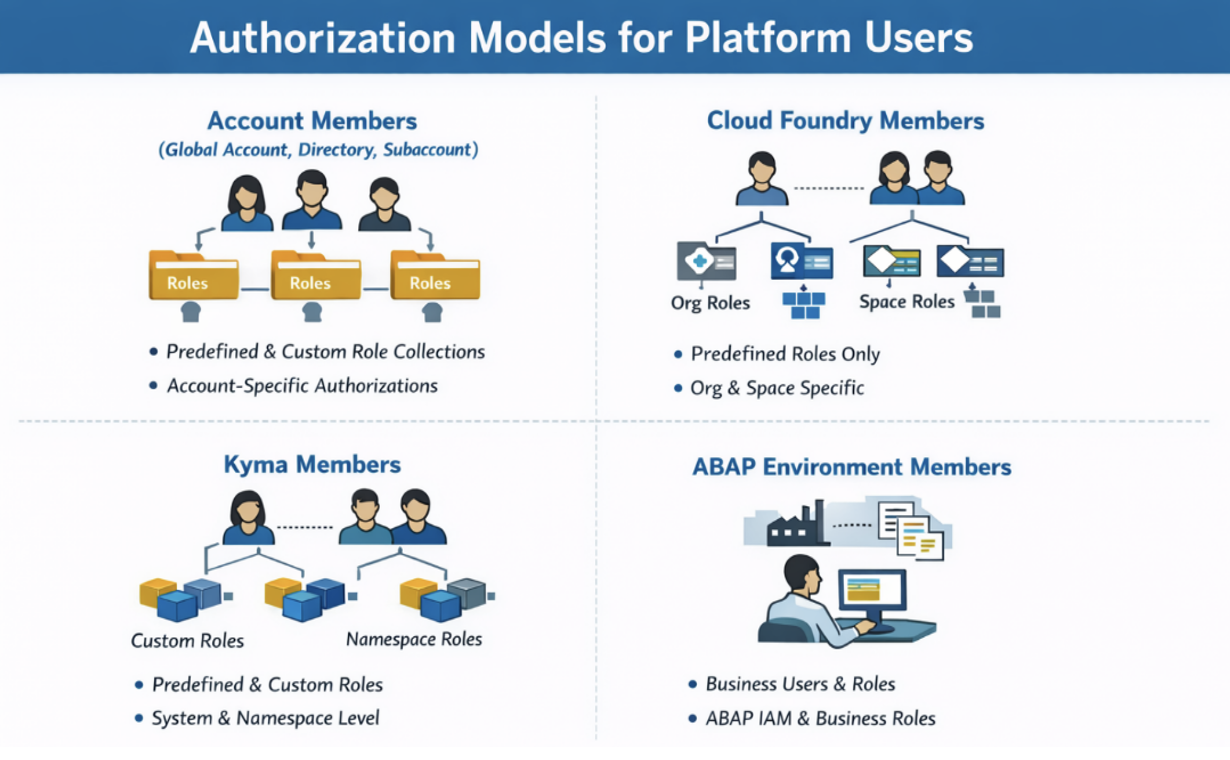
One of the reasons SAP BTP authorization is often misunderstood is because there is no single, uniform authorization behavior across all environments. Each runtime has its own model, and each one introduces different design considerations.
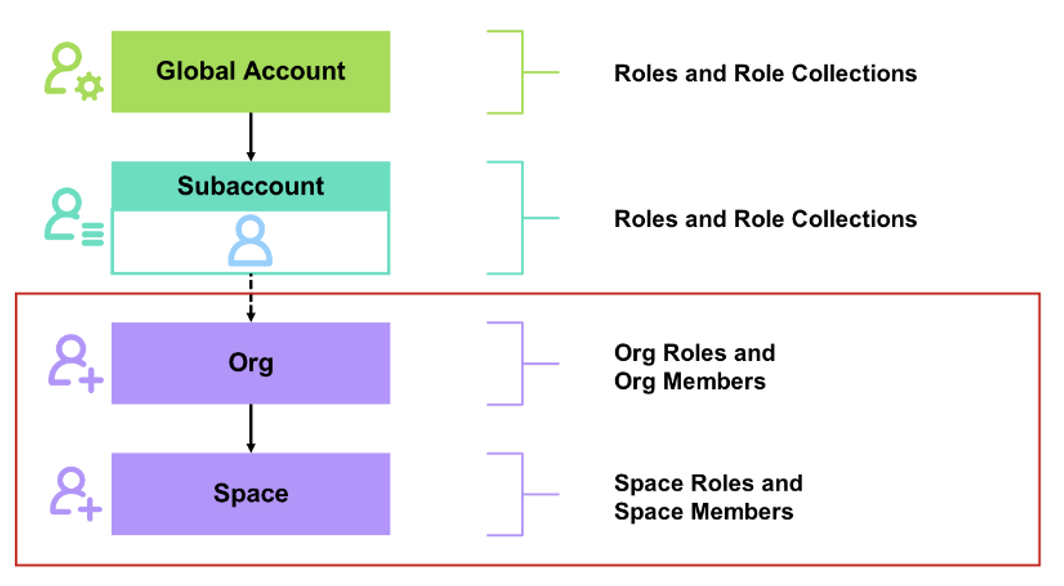 Image Source - SAP
In Cloud Foundry, authorization is comparatively structured and straightforward. Access is typically assigned through predefined roles at the organization and space levels. This makes the model relatively easy to understand and implement, especially for platform administration and development operations. However, while it is simple, it is not always sufficiently granular for more advanced enterprise control requirements.
In many implementations, this simplicity becomes a hidden weakness, as predefined roles are often assumed to be inherently safe without evaluating how broadly they are assigned across spaces and operational teams.
Kyma introduces a very different model. Because it is built on Kubernetes concepts, authorization becomes much more granular and much more flexible. Access can be governed at levels such as namespaces, and the model is far better suited for microservices, APIs, and cloud-native application architectures. But with that flexibility comes more responsibility. If Kyma access is not governed centrally, it can become one of the fastest ways for security sprawl to emerge in a BTP landscape.
Kyma often exposes the maturity gap between traditional SAP security teams and cloud-native platform security expectations, as authorization here behaves closer to Kubernetes and infrastructure access models than classic SAP role design.
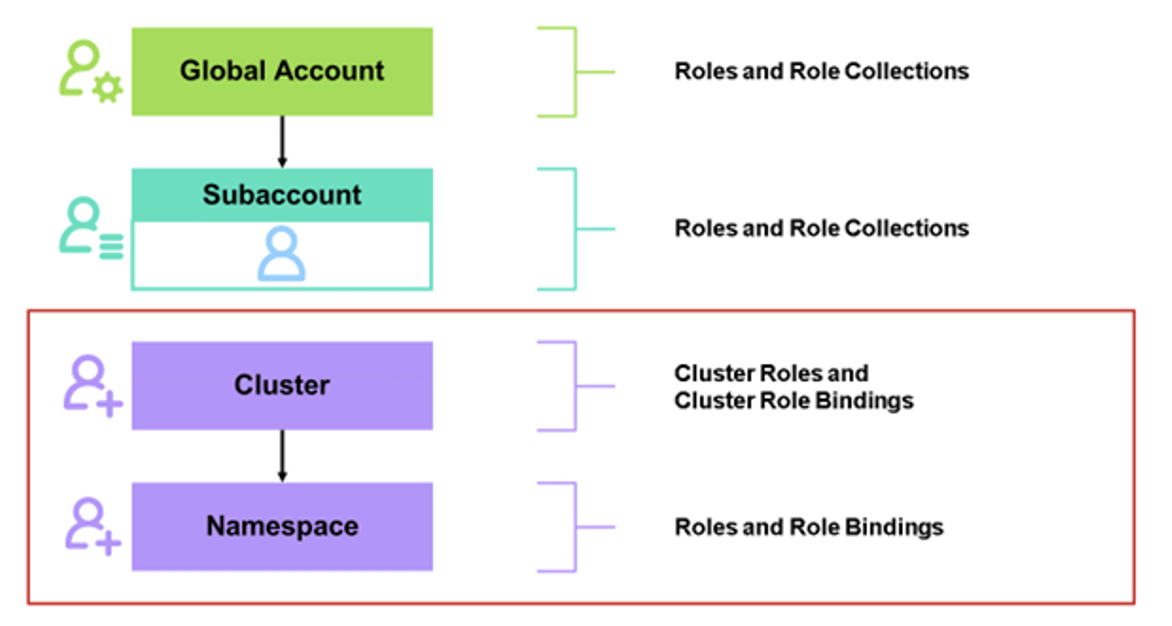 Image Source - SAP
The ABAP environment is different again. It aligns more closely with what traditional SAP security teams are already familiar with, using business roles, catalogs, and ABAP IAM principles. This often makes it easier for SAP authorization teams to understand, but it can also create a false sense of comfort. That familiarity can lead teams to underestimate broader BTP security dependencies such as identity federation, trust configuration, and platform-level governance. If the ABAP environment is governed in isolation rather than as part of a unified cloud access strategy, inconsistencies will eventually appear.
This diversity across runtimes is exactly why SAP BTP authorization cannot be designed environment by environment in silos. It requires a unified governance model that respects runtime differences without losing architectural consistency.
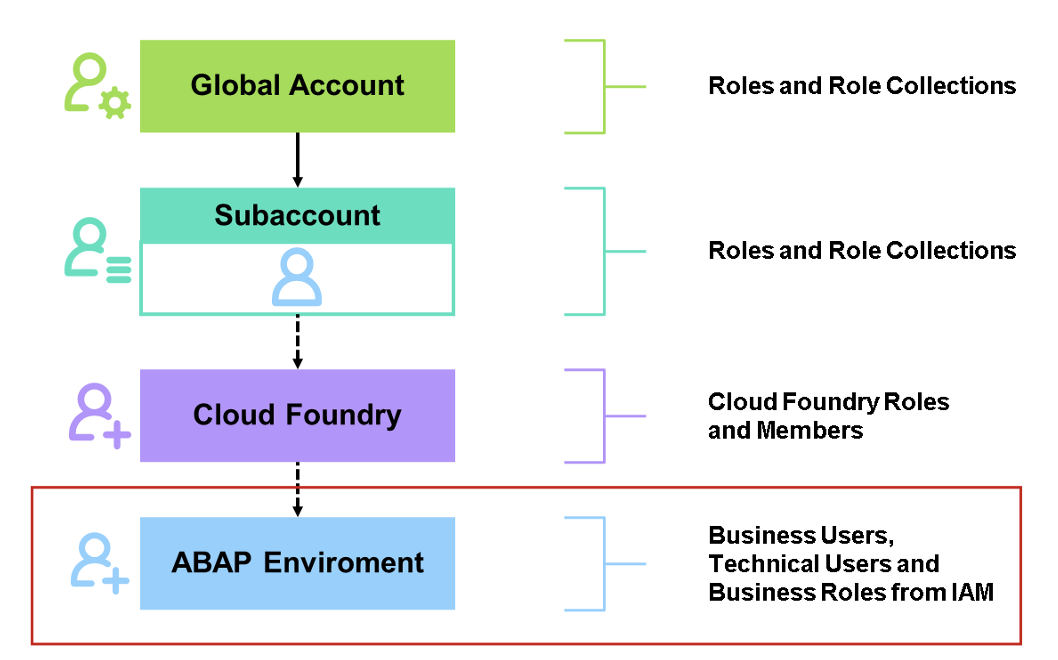 Image Source - SAP
The Evolution of Business User Authorization in SAP BTP
While platform user access is already a significant design area, the more important long-term shift in SAP BTP lies in business user authorization.
SAP is steadily moving toward a more advanced access model for business users through SAP Cloud Identity Services, especially with SAP Identity Authentication Service (IAS) and SAP Identity Provisioning Service (IPS). This reflects a broader strategic movement away from static, role-only access models and toward more flexible, policy-driven authorization.
This is where SAP BTP starts to move beyond traditional RBAC thinking.
In this emerging model, applications can define authorization policies that govern not only what a user can do, but also under what conditions they can do it. That means access can be determined by identity attributes, business context, or application-defined policy logic rather than broad functional roles alone.
This is particularly important for instance-based authorization.
Instead of granting a user blanket access to all records, all processes, or all business data, organizations can restrict access more intelligently by geography, business unit, operational scope, or another relevant attribute. This makes the model significantly more aligned with modern enterprise security expectations.
For SAP security professionals, this is an important shift to understand. The future of SAP BTP authorization is not simply “more roles.” It is more context-aware, more identity-driven, and more application-aware access design.
That is a very different security conversation than the one most SAP teams have traditionally been used to.
Common Risks in SAP BTP Authorization Design
SAP BTP provides a flexible and powerful authorization framework, but that flexibility also introduces risk when the model is not designed carefully.
One of the most common problems is over-provisioning through oversized role collections. When role collections are created for convenience rather than governance, they quickly become access bundles that contain far more than what users actually require. This is especially common in early-stage implementations where speed takes priority over control.
Another recurring issue is inconsistency in access design. When different teams define their own naming conventions, role structures, or provisioning logic across different subaccounts, the authorization model begins to fragment. This may not be immediately visible during implementation, but it becomes highly visible during access reviews, audits, or remediation exercises.
Identity misconfiguration is another serious risk area. In SAP BTP, identity-driven access is powerful, but it is also highly dependent on correct federation and attribute mapping. If user attributes are mapped incorrectly or trust configurations are poorly implemented, users can end up with the wrong access at scale.
Privileged access is also frequently underestimated. Administrative users in SAP BTP can often manage role collections, trust settings, services, and platform resources. If those privileges are not governed, reviewed, and monitored properly, they can become one of the most significant control weaknesses in the environment.
Finally, many organizations focus heavily on user access while overlooking API and service authorization. In cloud platforms, access is not only granted to people. It is also granted to applications, integrations, and machine identities. Weak OAuth scope governance or overly broad service permissions can create exposure that is much harder to detect than traditional user access issues.
These are not edge cases. They are becoming standard enterprise security concerns in modern SAP landscapes.
In real SAP BTP programs, authorization challenges rarely arise from platform limitations. They usually emerge from reactive access decisions made over time, without a consistent design standard. Once that pattern sets in, complexity becomes difficult to reverse.
Design Best Practices for SAP BTP Authorization
A strong SAP BTP authorization model is not created by assigning access as requests come in. It is created by defining a structure early and governing it consistently.
The first principle is role clarity. Every role and role collection should exist for a clearly defined purpose. If access cannot be explained in business or technical terms, it should be challenged. Clean access models are not created by adding more structure later; they are created by avoiding unnecessary complexity at the beginning.
The second principle is modular design. Role collections should be reusable, logically grouped, and intentionally scoped. Large, catch-all collections may feel efficient in the short term, but they create long-term control and audit problems. Modular access design is far easier to govern, review, and evolve.
A third principle is identity-driven provisioning. Where possible, organizations should use IAS and IPS to automate and standardize access assignment rather than relying on heavy manual administration. This improves consistency and reduces the chance of access being handled differently across teams or sub-accounts.
Least privilege also needs to be embedded into the architecture from the start. In many projects, least privilege becomes a slogan that is only revisited after access has already expanded too far. In SAP BTP, that approach becomes especially dangerous because of how quickly cloud platforms scale. If least privilege is not designed intentionally, it is rarely restored effectively later.
Segregation of Duties must also remain part of the conversation. Just because a process has moved into SAP BTP does not mean classic access risks disappear. In fact, they often become harder to see because they emerge through custom applications, platform administration, APIs, and workflow extensions rather than traditional transaction-based access combinations.
Finally, governance must be standardized across the landscape. This includes naming conventions, access ownership, provisioning rules, privileged access review, and logging. SAP BTP becomes difficult to secure not because the platform lacks capability, but because organizations allow too many inconsistent security decisions to accumulate over time.
Final Thought
SAP BTP authorization is often treated as a technical configuration topic, but that view is far too narrow.
In reality, authorization in SAP BTP is a cloud governance issue, an identity architecture issue, and a security design issue all at once. It determines how trust is established between users, applications, services, and platform resources across an increasingly distributed SAP ecosystem.
That is why it deserves much more attention than it usually gets in early project phases.
A well-designed authorization model gives organizations control, scalability, auditability, and resilience. A weak one creates long-term operational friction and security debt that becomes expensive to unwind.
In the SAP BTP world, authorization is no longer just about assigning access. It is about designing how trust, control, and access should work in the cloud.