The primary reason is that risks are growing fast as organizations are using SAP BTP to build applications, automate workflows, integrate systems, extend SAP S/4HANA, connect third-party platforms, and accelerate innovation with AI and analytics.
It is no longer just a transactional system or user interface layer. It is now the digital layer where many future business processes and interconnected systems run.
Industry research reports from IBM, Verizon and Gartner consistently highlight identity governance gaps, excessive privilege, and cloud misconfiguration remain among the most common causes of enterprise security exposure. As organizations expand into SAP BTP, those same risks can scale faster if controls are not designed early.
The reality that many teams discover too late:
- Security is not necessary in SAP BTP, as it is a cloud-based application
- There are no traditional transaction codes or apps that require access governance.
- It is a BASIS or cloud architect job.
In many transformation programs, security is only revisited after the first wave goes live. By then, roles are already assigned, integrations are active, and remediation becomes more expensive than getting the model right up front.
If SAP BTP security is not designed early, complexity multiplies quickly.
- Access models become inconsistent.
- Identities sprawl across systems.
- Developers receive broad permissions.
- Integrations move data without sufficient controls.
- Audits become difficult, with evidence requests no one planned for.
The good news is this can be avoided.
Organizations that establish the right security foundations early move faster, scale better, and reduce expensive remediation later.
Why SAP BTP Security Matters More Than Many Realize
Unlike traditional on-premise SAP landscapes, SAP BTP is dynamic by design.
New services can be activated quickly. Applications can be built rapidly. APIs can be exposed externally. Users may include employees, vendors, customers, developers, bots, and external identities.
That flexibility is powerful. It is also where governance gaps begin.
Security in SAP BTP is not about blocking access to transaction codes or Fiori apps. It is about controlling trust across a rapidly expanding ecosystem.
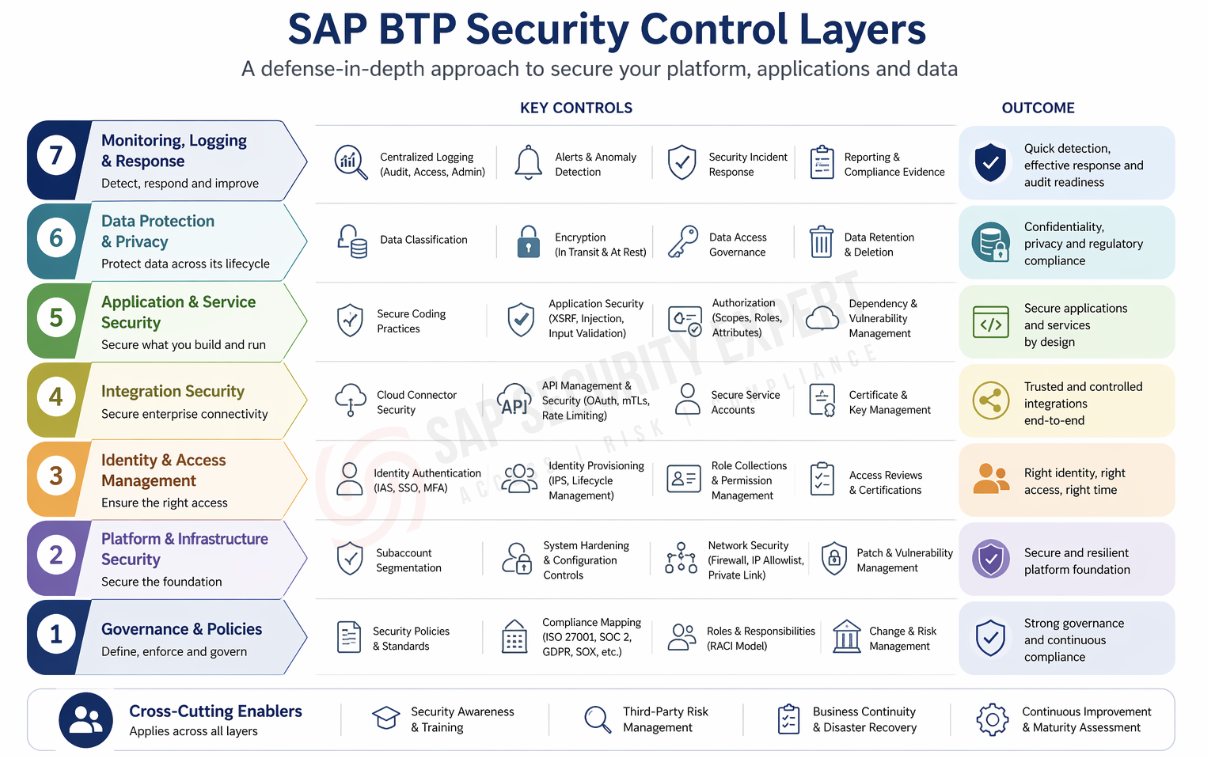
A practical defense-in-depth model for securing identities, integrations, applications, data, and platform operations in SAP BTP.
That includes:
- Who can access what
- How identities are authenticated
- What data moves between systems
- Which developers can deploy changes
- How privileged actions are monitored
- Whether compliance evidence exists when required
If these controls are unclear in the first phase, they become harder to fix after scale.
What Organizations Need to Get Right Early
1. Identity Architecture Before User Creation
Many security issues start with a simple question no one answered properly:
How will identities be managed across SAP BTP and connected systems?
This often includes decisions around Identity Authentication Service (IAS), Identity Provisioning Service (IPS), federation with enterprise identity providers, and lifecycle governance across connected platforms.
Some organizations create local users. Others federate through corporate identity providers. Some mix both without clear policy.
That creates fragmentation.
A better approach is to define identity architecture upfront using enterprise identity governance principles. Decide early how users will authenticate, how lifecycle changes will occur, and how access removal will happen when people move roles or leave.
Typical questions to settle early:
- Will you use single sign-on?
- Which identity provider is authoritative?
- How are contractors handled?
- How are emergency access scenarios managed?
- What is the deprovisioning process?
Security maturity often begins here.
2. Role Design Before Role Explosion Begins
Many SAP environments suffer from years of role sprawl. SAP BTP can repeat the same problem faster if left unmanaged.
Once dozens of role collections are created without standards, cleanup becomes a governance program of its own.
When projects launch quickly, permissions are often granted for convenience. Teams later discover dozens of overlapping roles, excessive privileges, and poor visibility.
Instead, design access around business responsibilities, not individual requests.
Examples:
- Integration administrator
- Application developer
- Security administrator
- Read-only operations analyst
- Business approver
Role models should be structured, documented, and reviewed before mass onboarding begins.
The earlier this is done, the easier governance becomes.
3. Developer Access with Guardrails
Innovation teams need speed. That is true. But unrestricted developer access creates avoidable risk.
Developers may need access to environments, logs, APIs, and deployment tools. They usually do not need unrestricted production control or permanent elevated privileges.
Strong organizations separate development freedom from production governance.
Mature teams embed these controls into release pipelines so security becomes part of delivery, not a manual checkpoint after deployment.
That means:
- Segregating dev, test, and production access
- Limiting direct production changes
- Logging deployments and admin activity
- Using approvals for elevated access
- Reviewing privileged assignments regularly
This is where modern DevSecOps discipline matters.
4. Integration Security from Day One
SAP BTP often becomes the bridge between SAP and non-SAP systems. That means APIs, connectors, middleware flows, webhooks, and data exchanges become part of the security perimeter.
Yet integration accounts are frequently overlooked.
In practice, some of the highest-risk accounts in an environment are non-human identities because they often run continuously and access multiple systems unnoticed.
Common mistakes include:
- Shared technical users
- Hardcoded credentials
- Excessive API permissions
- No ownership of service accounts
- Weak certificate management
- Limited monitoring of failed or suspicious calls
Treat integrations as identities with risk, not background plumbing.
If a machine account has broad access, it can create the same damage as a human account.
5. Data Protection Beyond Simple Access Control
Not every security issue is an identity issue.
Many organizations use SAP BTP for analytics, automation, AI scenarios, workflow data, or customer-facing applications. That can involve personal data, financial data, supplier records, or sensitive operational information.
Early governance should include:
- Data classification
- Encryption strategy
- Logging of sensitive access
- Retention controls
- Secure data movement rules
- Regulatory alignment with GDPR, DPDPA, SOX, or industry obligations
For regulated organizations, this is no longer just good practice. It is often necessary to support GDPR, DPDPA, SOX, internal audit requirements, and customer assurance commitments.
If security only focuses on login access, the broader data risk remains exposed.
6. Visibility and Monitoring Before Incidents Happen
One of the most expensive moments in security is after an incident, when leadership asks:
What happened?
That question becomes far more difficult to answer when logging was not enabled from day one.
If logs are incomplete, monitoring was not enabled, or ownership is unclear, recovery becomes harder and trust declines quickly.
Organizations should establish observability early:
- Admin activity logs
- Authentication events
- Failed access attempts
- Configuration changes
- Integration anomalies
- Privileged usage trends
Monitoring should not wait for an audit or breach.
7. Governance Ownership Across Teams
SAP BTP security is rarely owned by one team alone. It touches:
- SAP teams
- Cloud teams
- IAM teams
- Developers
- Infrastructure teams
- Internal audit
- Compliance leaders
Without a governance model, gaps appear between responsibilities.
Most control failures do not happen because nobody cared. They happen because everyone assumed someone else owned it.
For example:
The SAP team assumes IAM owns access reviews. IAM assumes application owners do. Audit assumes both do.
Define accountability early. Document decision rights. Build operating rhythm across teams.
Security failures often occur in the spaces between teams.
What Happens When Security Is Delayed
When organizations postpone SAP BTP security, common outcomes include:
- Rework of access models after go-live
- Audit findings around privileged access
- Manual user administration overhead
- Inconsistent controls across projects
- Higher remediation costs
- Slower onboarding of new initiatives
- Increased cyber exposure
A Practical Early-Stage SAP BTP Security Checklist
Before expansion accelerates, leadership teams should be able to answer these questions confidently:
- Is identity architecture approved?
- Are roles based on business responsibilities?
- Are privileged permissions controlled?
- Are integrations governed securely?
- Is sensitive data protected properly?
- Are logs enabled and reviewed?
- Is ownership defined across teams?
- Can audit evidence be produced quickly?
If several answers are unclear, now is the right time to act.
Final Thought
SAP BTP creates enormous opportunity. It helps organizations modernize faster, integrate smarter, and innovate beyond traditional ERP boundaries.
But every new platform becomes part of the enterprise control environment.
The companies that succeed long term are not the ones that add security after growth. They are the ones that build trust into the platform from the beginning.
The cost of early design is small. The cost of late remediation is usually not.
In SAP BTP, early security is not a brake on innovation.
It is what makes innovation sustainable.