In SAP landscapes, these challenges are not theoretical. Orphan users remain active long after exit, access accumulates over time, provisioning delays impact productivity, and fragmented authentication weakens control. Each of these issues directly expands the attack surface and creates audit exposure.
This is where SAP Cloud Identity Services (CIS) becomes essential - not as an add-on, but as a foundational layer for identity control. It provides a centralized identity layer that unifies authentication, provisioning, and lifecycle management, ensuring access is consistently aligned with business roles and security policies.
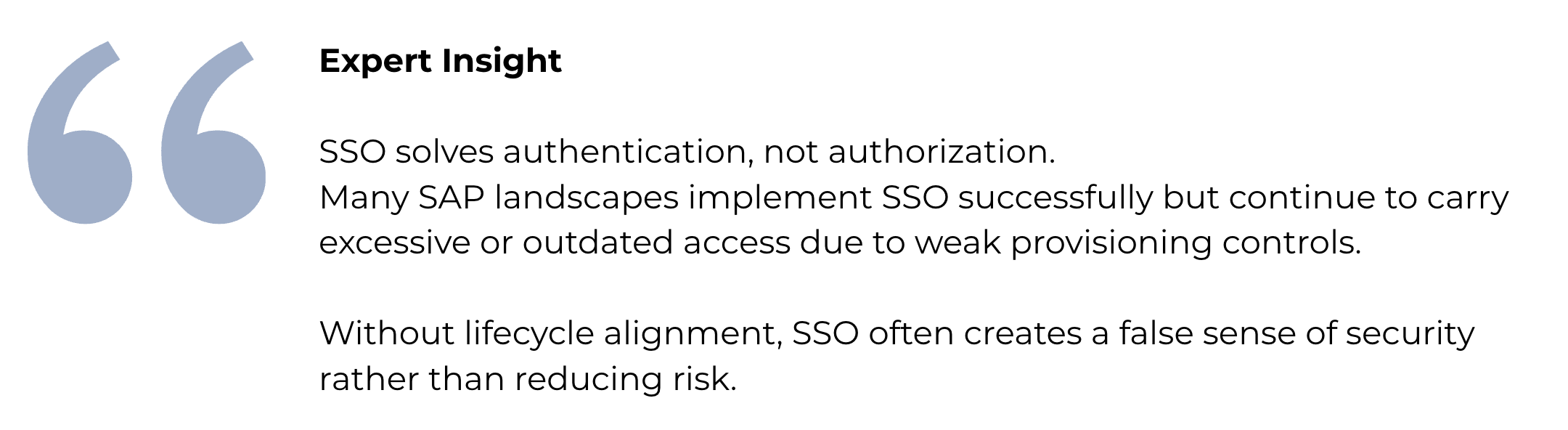
Many organizations implement SSO and assume identity is solved. In reality, without provisioning and lifecycle alignment, SSO alone often creates a false sense of security.
From Real SAP Implementations
Across multiple S/4HANA and SAP BTP programs, a consistent pattern emerges. Most enterprises already operate with a corporate identity provider such as Microsoft Entra ID or Okta, while SAP applications demand tightly integrated single sign-on and role-based provisioning.
The real challenge is not authentication - it is the alignment between authentication and authorization. Manual provisioning introduces delays, inconsistencies, and audit findings, especially in hybrid landscapes.
A practical architecture typically introduces Identity Authentication (IAS) as the trust layer and Identity Provisioning Service (IPS) as the automation engine. Together, they bridge SAP and non-SAP systems using SCIM and APIs, significantly reducing manual intervention while strengthening control.
This approach not only reduces manual effort but also introduces consistency between authentication and authorization, which is often the missing link in SAP security architectures.
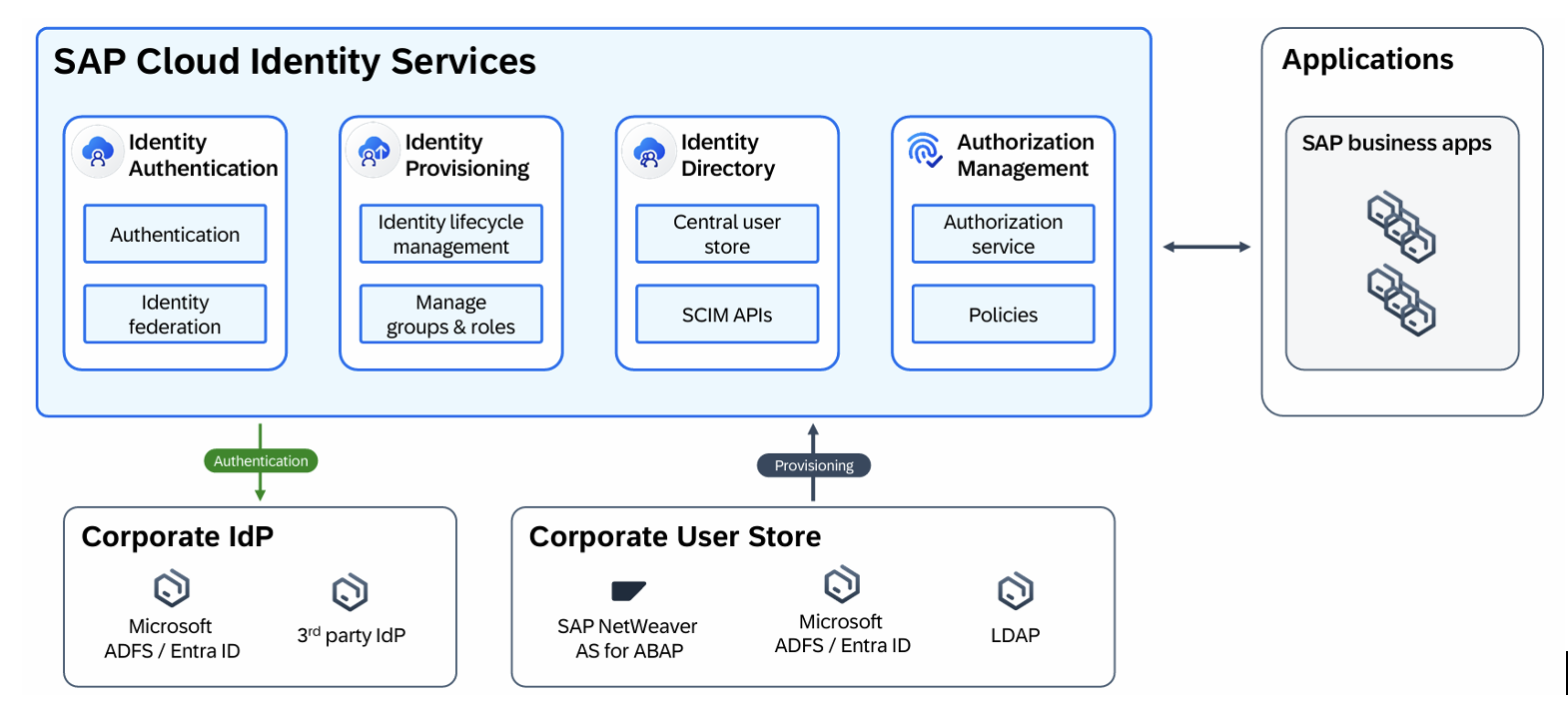
Image source - SAP
Understanding the SAP CIS Architecture
The architecture of SAP Cloud Identity Services is designed around a clear separation of responsibilities, with each component playing a distinct role in the identity lifecycle.
At the entry point, users authenticate through Identity Authentication (IAS), which acts as the central trust layer. IAS either authenticates users directly or federates authentication to a corporate identity provider such as Microsoft Entra ID or Okta.
Behind the scenes, Identity Provisioning Service (IPS) manages the movement of identity data across systems. It connects to corporate user stores as source systems and provisions users into SAP applications and other target systems, ensuring that identity data remains consistent across the landscape.
Corporate identity providers and directories, such as Entra ID, LDAP, or SAP systems, serve as the authoritative source of user information. IPS continuously synchronizes this data, applying transformation and mapping rules where required.
Finally, SAP business applications rely on this integrated setup for both authentication and authorization, ensuring that users not only log in seamlessly but also receive the correct level of access.
This layered architecture ensures that authentication, provisioning, and application access are decoupled yet tightly coordinated - providing both flexibility and control in complex enterprise environments.
What is Identity and Access Management (IAM) in SAP?
In SAP landscapes, Identity and Access Management (IAM) is responsible for controlling who can access what, under which conditions, and for how long.
Without a centralized IAM layer, organizations face fragmented authentication, inconsistent access provisioning, and limited visibility into user activity. Over time, this leads to excessive authorizations and increased compliance risk.
SAP Cloud Identity Services addresses this by introducing a central identity control plane, enabling secure authentication, consistent authorization, and automated lifecycle management across SAP and non-SAP applications.
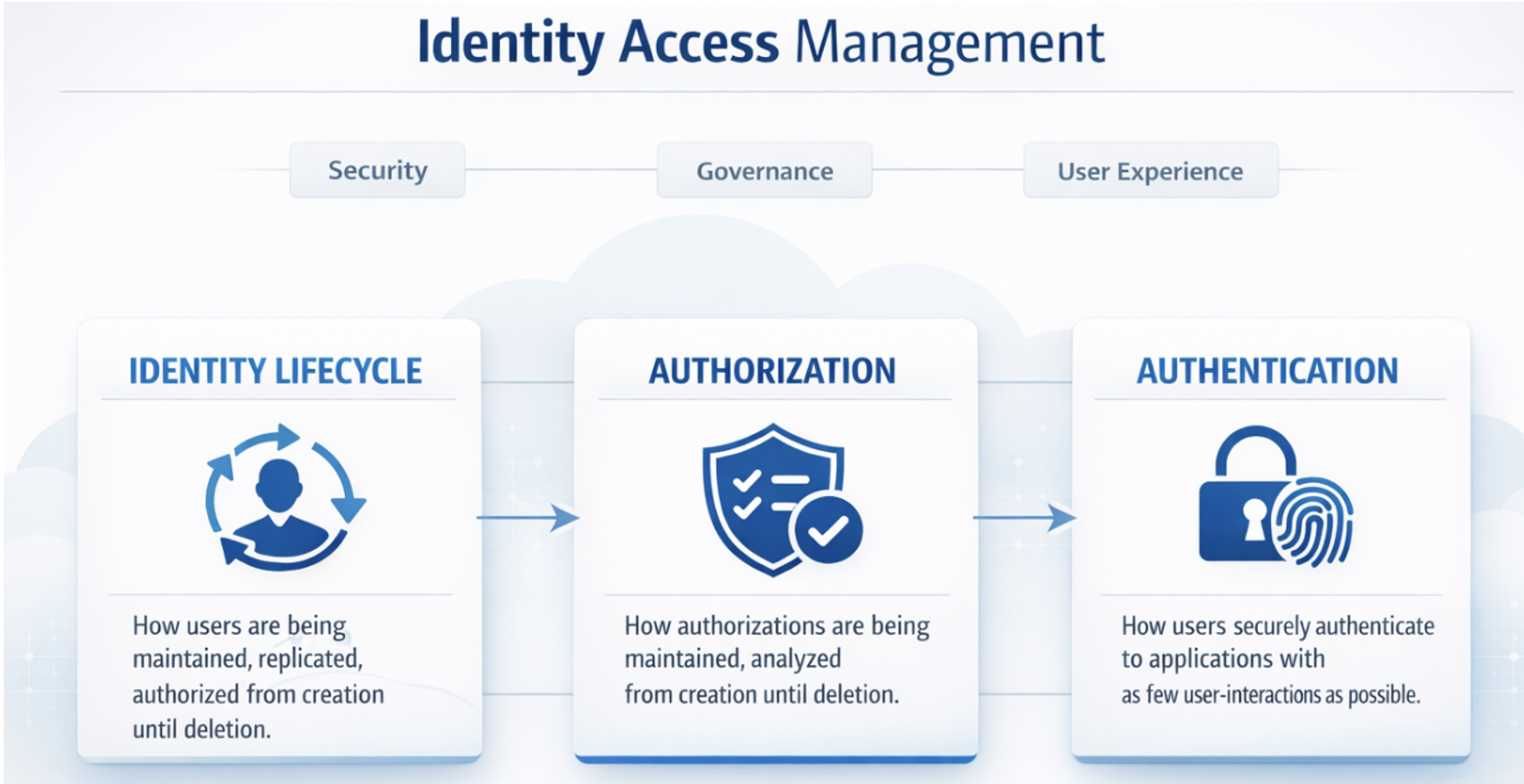 This separation of authentication, authorization, and provisioning is critical, as many SAP security issues originate from treating these layers in isolation rather than as a unified control model.
In practice, this means identity decisions are no longer system-specific - they are enforced consistently across the entire SAP landscape.
Risks Without SAP Cloud Identity Services
Without a centralized identity platform, access control gradually becomes unreliable. Users who leave the organization may still retain active access, while others accumulate permissions that are no longer relevant to their roles.
Authentication mechanisms often vary across systems, creating inconsistent user experiences and weak control points. Over time, this lack of standardization leads to audit challenges, limited traceability, and delayed provisioning cycles that directly impact business operations.
SAP Cloud Identity Services addresses these issues by introducing a centralized and enforceable identity control layer, eliminating fragmentation across systems.
Why Organizations Adopt SAP Cloud Identity Services
Organizations adopt SAP Cloud Identity Services not just for convenience, but to establish a scalable and controlled identity architecture.
Instead of managing multiple point-to-point integrations, CIS introduces a centralized identity layer that simplifies connectivity across SAP and non-SAP systems. This significantly reduces integration complexity while enabling faster onboarding of new applications.
At the same time, Identity Provisioning ensures that user access is managed automatically across the landscape, eliminating manual intervention. With native support for SAP BTP and standardized SCIM-based integrations, CIS aligns seamlessly with modern cloud-first strategies.
While the architecture provides strong capabilities, its effectiveness depends heavily on how it is implemented.
Common Mistakes in SAP CIS Implementation
While SAP Cloud Identity Services provides a powerful and flexible identity architecture, many implementations fail to deliver expected outcomes due to architectural misalignment rather than technical limitations.
One of the most common mistakes is treating IAS purely as a login mechanism instead of a trust layer. When IAS is not positioned correctly between SAP applications and the corporate identity provider, organizations lose the ability to standardize authentication flows and enforce consistent policies.
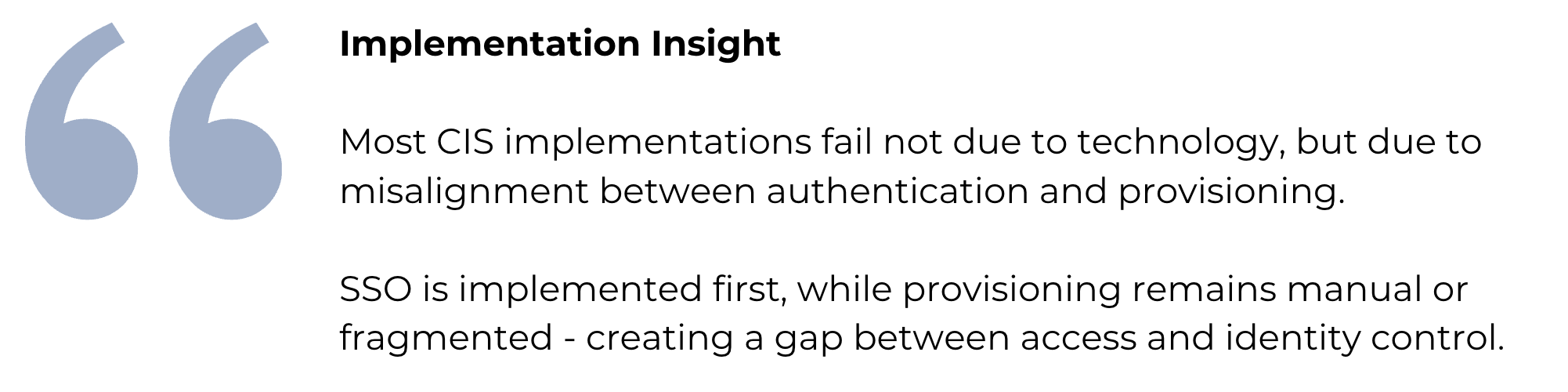
Another frequent issue is the disconnect between authentication and provisioning. Many landscapes implement single sign-on successfully but continue to rely on manual or fragmented provisioning processes. This creates a gap where users can authenticate correctly but still carry excessive or outdated authorizations.
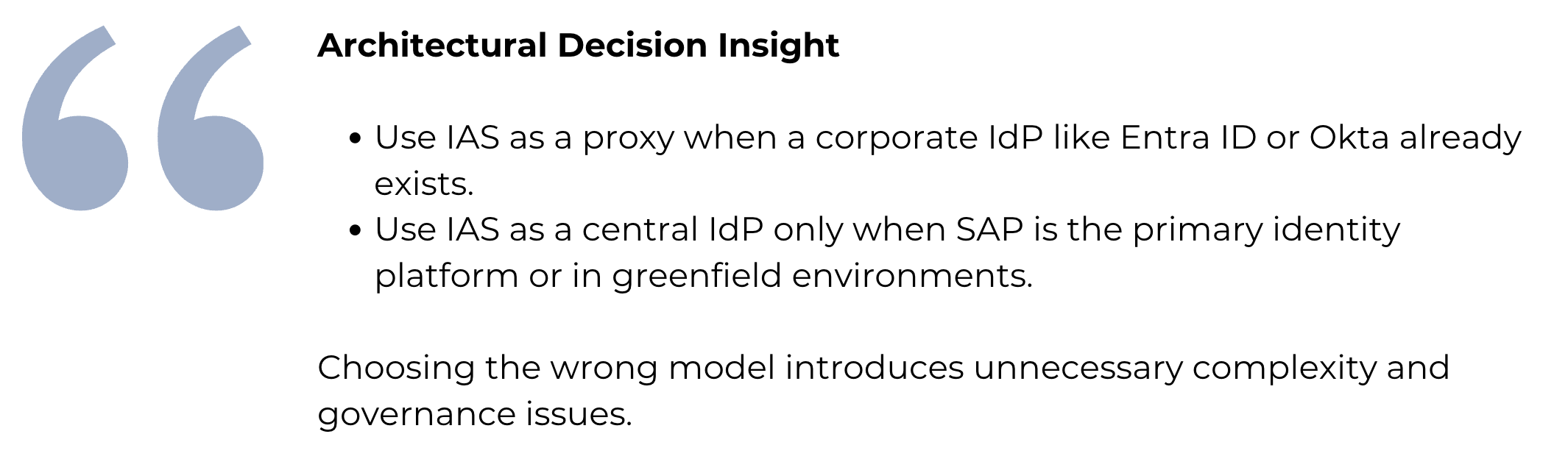
Improper use of IAS as a central identity provider in already mature IAM environments is another challenge. In such cases, duplicating identity management instead of leveraging IAS as a proxy introduces unnecessary complexity and governance issues.
Finally, insufficient attention to lifecycle management leads to lingering access risks. Without tightly integrated provisioning and deprovisioning, access revocation is often delayed, leaving systems exposed even after users leave the organization.
Successful CIS implementations treat identity as a continuous control process, where authentication, authorization, and provisioning are tightly aligned rather than independently managed.
With this architectural foundation in place, the next step is understanding how authentication is enforced across the landscape.
Authentication & Single Sign-On (SSO) in SAP CIS
SAP Cloud Identity Services uses Identity Authentication (IAS) to provide secure authentication and SSO. It supports industry standards such as SAML 2.0 and OpenID Connect (OIDC), enabling seamless federation with corporate identity providers like Microsoft Entra ID and Okta.
In addition, IAS supports certificate-based authentication, including X.509-based login for SAP GUI, ensuring compatibility across both modern cloud applications and traditional SAP access scenarios.
In most enterprise architectures, SAP applications are configured to trust IAS, while IAS itself federates with the corporate identity provider. This establishes IAS as a trust broker, decoupling SAP systems from direct dependency on external identity providers.
Identity Authentication in SAP Cloud Identity Services
Identity Authentication in SAP Cloud Identity Services
This architectural choice often determines whether CIS simplifies or complicates the overall identity landscape:
Expert Insight:
IAS should be positioned as a proxy when an organization already operates a mature IAM platform such as Entra ID or Okta. In contrast, IAS can act as the central identity provider in SAP-first or greenfield environments where a unified identity strategy is being established.
Conditional Authentication
SAP IAS enables context-aware authentication by evaluating multiple parameters during login, including network location, user attributes, authentication method, and device context.
This allows organizations to move beyond static authentication models and implement adaptive access control, where access decisions are dynamically adjusted based on risk signals.
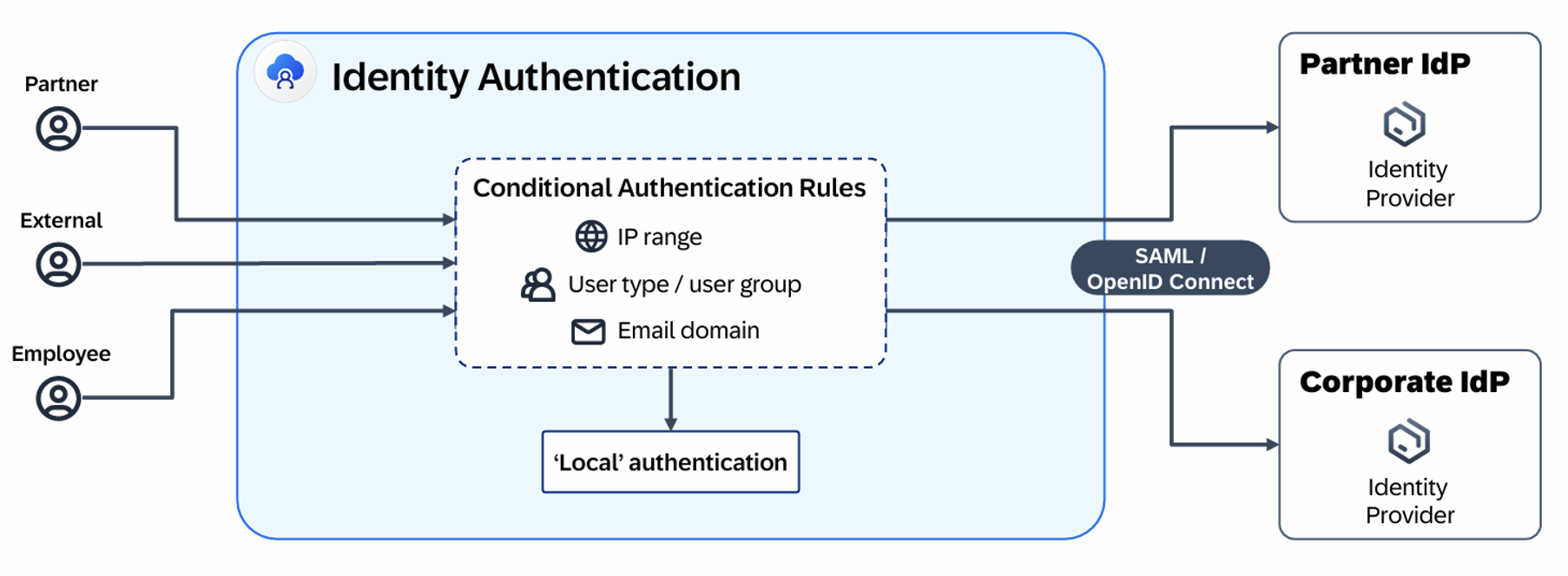 Image Source - SAP
This approach is a key enabler for zero-trust security models, where access is continuously evaluated rather than implicitly trusted.
Password management
SAP IAS provides flexible password policy controls that allow organizations to align authentication strength with their security requirements. Administrators can enforce policies related to password complexity, expiration, lockout behavior, and recovery mechanisms.
Beyond standard configurations, IAS also enables customization of password reset flows, email validation mechanisms, and notification triggers. This ensures that password management is not just secure, but also aligned with user experience and compliance requirements.
Multi-factor authentication (MFA)
SAP IAS strengthens authentication by introducing additional verification layers such as time-based one-time passwords, authenticator app integrations, and certificate-based authentication.
This becomes particularly important in scenarios involving privileged users, external access, or regulatory requirements, where a single authentication factor is no longer sufficient.
Risk-based authentication – Controlling application access
SAP Cloud Identity Services introduces a context-aware approach to access control, where decisions are evaluated dynamically rather than relying solely on static credentials.
When a user attempts to access an application, multiple contextual factors are evaluated in real time, including user type, network location, authentication method, group membership, and application authorization. Additional attributes from the corporate identity provider, such as department or role-further enrich this decision-making process.
This enables organizations to enforce fine-grained and adaptive access control, significantly reducing the risk of unauthorized access.
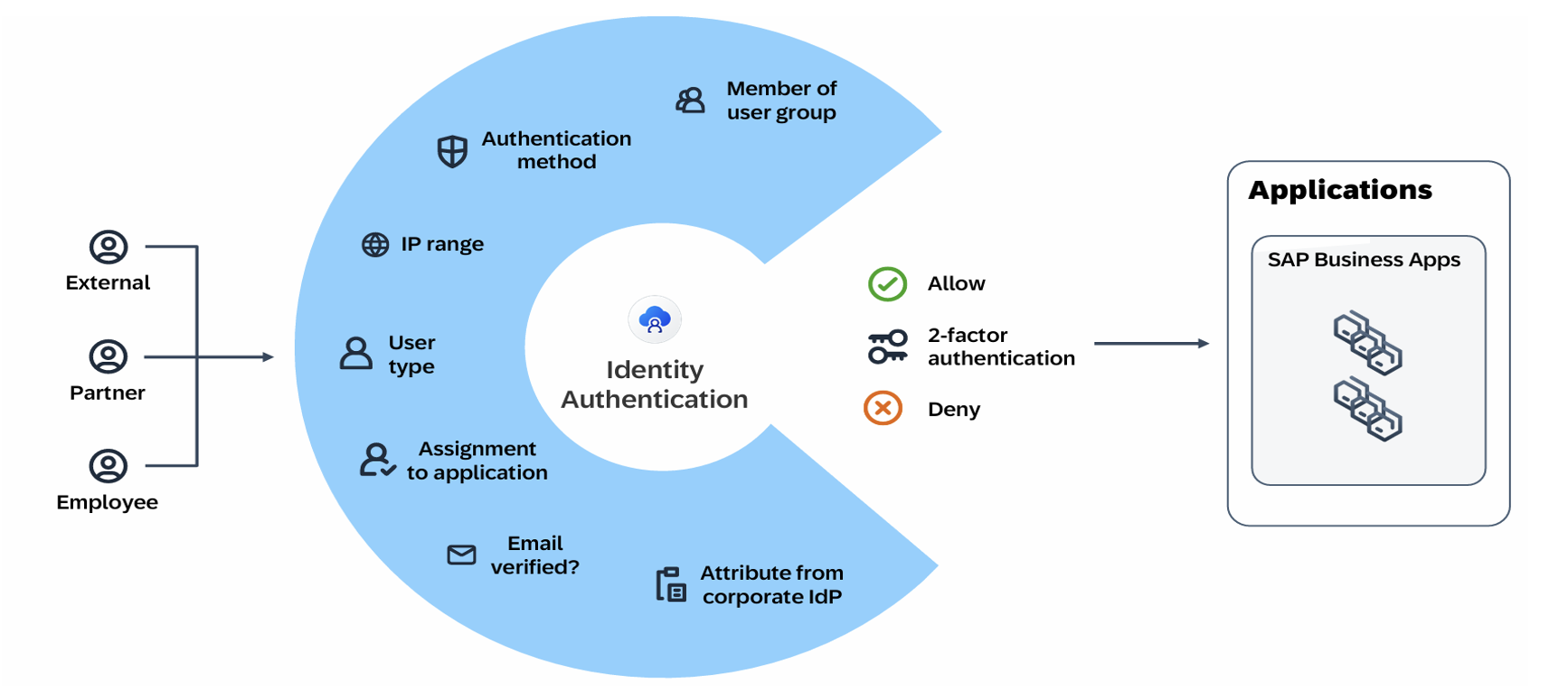 Image Source - SAP
Branding and customization
SAP IAS allows organizations to tailor the authentication experience to align with corporate identity standards. This includes customization of logos, UI themes, login texts, and email templates, along with support for CSS-based enhancements.
Identity Provisioning Service (IPS) – The Backbone of Automation
Identity Provisioning Service (IPS) handles user provisioning across SAP and non-SAP systems, while also transforming identity attributes and enabling real-time synchronization using SCIM.
As a result, access is provisioned immediately during onboarding, updated dynamically during role changes, and revoked without delay during offboarding.
This tight integration between provisioning and authentication ensures that identity data remains consistent across the landscape, while also making identity changes immediately enforceable across all connected systems.
Identity Lifecycle Management
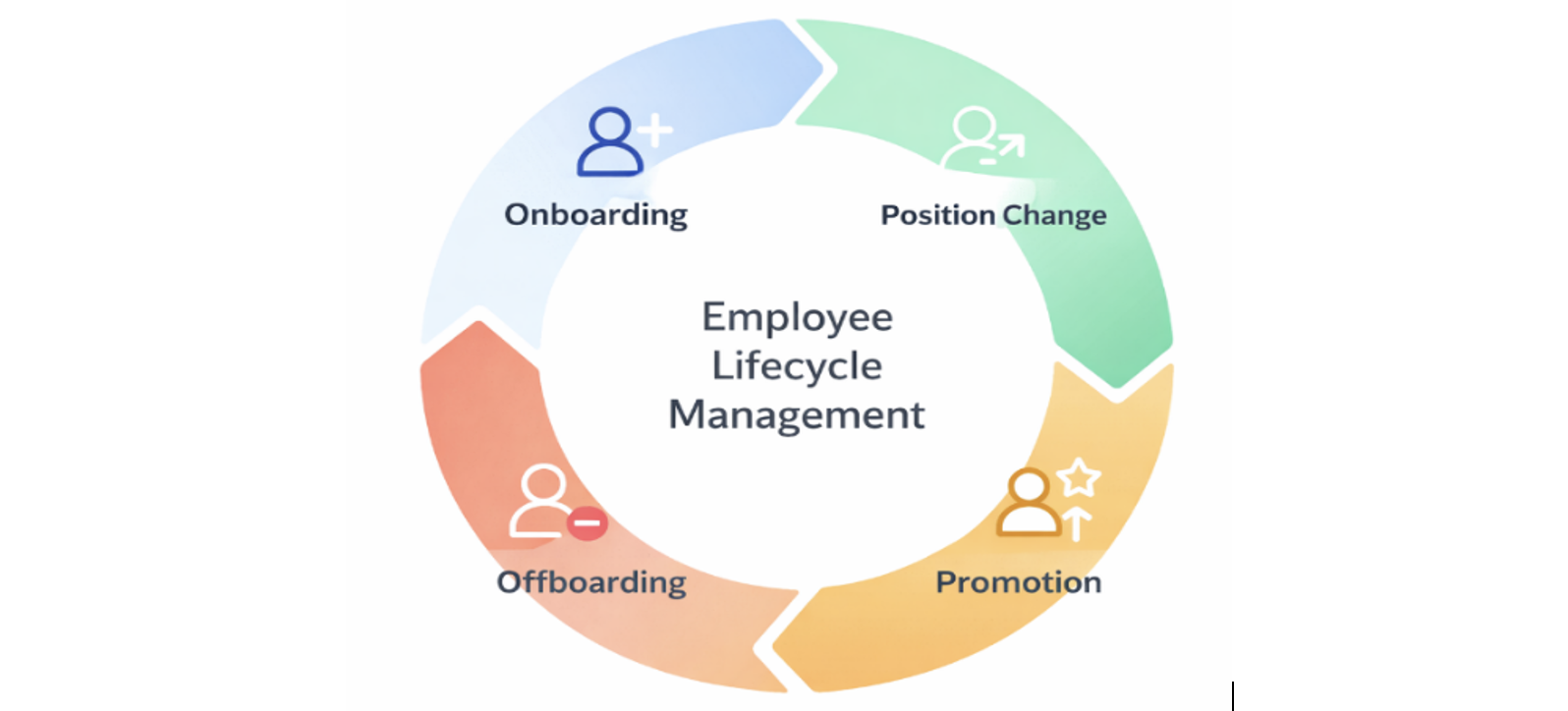
The employee lifecycle in cloud environments follows a continuous and dynamic process:
In a modern enterprise landscape, managing an employee’s journey, from the day they join until they leave - is a continuous and dynamic process. This journey, often referred to as the employee lifecycle, includes onboarding, role changes, promotions, transfers, and offboarding. In cloud environments, this lifecycle becomes even more critical due to the number of interconnected systems and applications involved. SAP Cloud Identity Services enables organizations to manage this entire lifecycle in a centralized, automated, and secure manner.
Onboarding: When a new employee joins, their identity is automatically created and provisioned across required systems based on predefined rules. Access is granted according to their role, department, and location.
Role Changes & Transfers: As employees move within the organization, their access is dynamically updated to reflect their new responsibilities—ensuring they have the right access without manual intervention.
Promotion: Elevated roles and responsibilities trigger updates in authorizations, maintaining alignment with business requirements while ensuring compliance.
Offboarding: When an employee exits, their access is promptly revoked across all connected systems, reducing the risk of unauthorized access and ensuring security.
This end-to-end lifecycle management not only improves operational efficiency but also strengthens governance, compliance, and security across the enterprise.
Capabilities of the Identity Provisioning Transformation Engine
The Identity Provisioning Transformation Engine lies at the core of SAP Cloud Identity Services, enabling flexible and rule-based processing of identity data. It allows organizations to define assignment logic based on attributes such as organizational structure, map identity fields across systems, and control which data is provisioned - ensuring consistency and accuracy across the landscape.
Connector types
Source systems - A source system is the connector used for reading entities (users, groups, roles). Source systems can be on-premise or cloud-based, SAP or non-SAP, and usually represent the corporate user store where identities are currently maintained.
Target systems - A target system is the connector used for writing (provisioning) entities. Target systems are usually clouds, where Identity Provisioning creates or updates the entities taken from the source system.
Proxy systems - A proxy system is a special connector used for "hybrid" scenarios. It exposes any Identity Provisioning supported backend system as a SCIM 2.0 service provider, which can be consumed by any SCIM 2.0 compatible client application.
This abstraction layer is critical in hybrid landscapes, where identity data must flow seamlessly between on-premise and cloud environments.
Real-time provisioning
Real-time provisioning enables identities and access to be created instantly across connected systems. This is particularly critical in scenarios such as user self-registration or time-sensitive access requirements, where delays can impact both user experience and operational efficiency.
Conclusion
SAP Cloud Identity Services is not just an integration layer-it is the foundation of identity security in modern SAP landscapes.
By unifying authentication through IAS and provisioning through IPS, organizations gain centralized control over identities, reduce operational complexity, and significantly strengthen their security posture.
As enterprises continue to expand across hybrid and cloud environments, CIS becomes the central trust layer that ensures access remains controlled, consistent, and compliant at scale.
Organizations that treat identity as a control layer rather than an integration component are the ones that achieve both security and scalability in SAP environments.