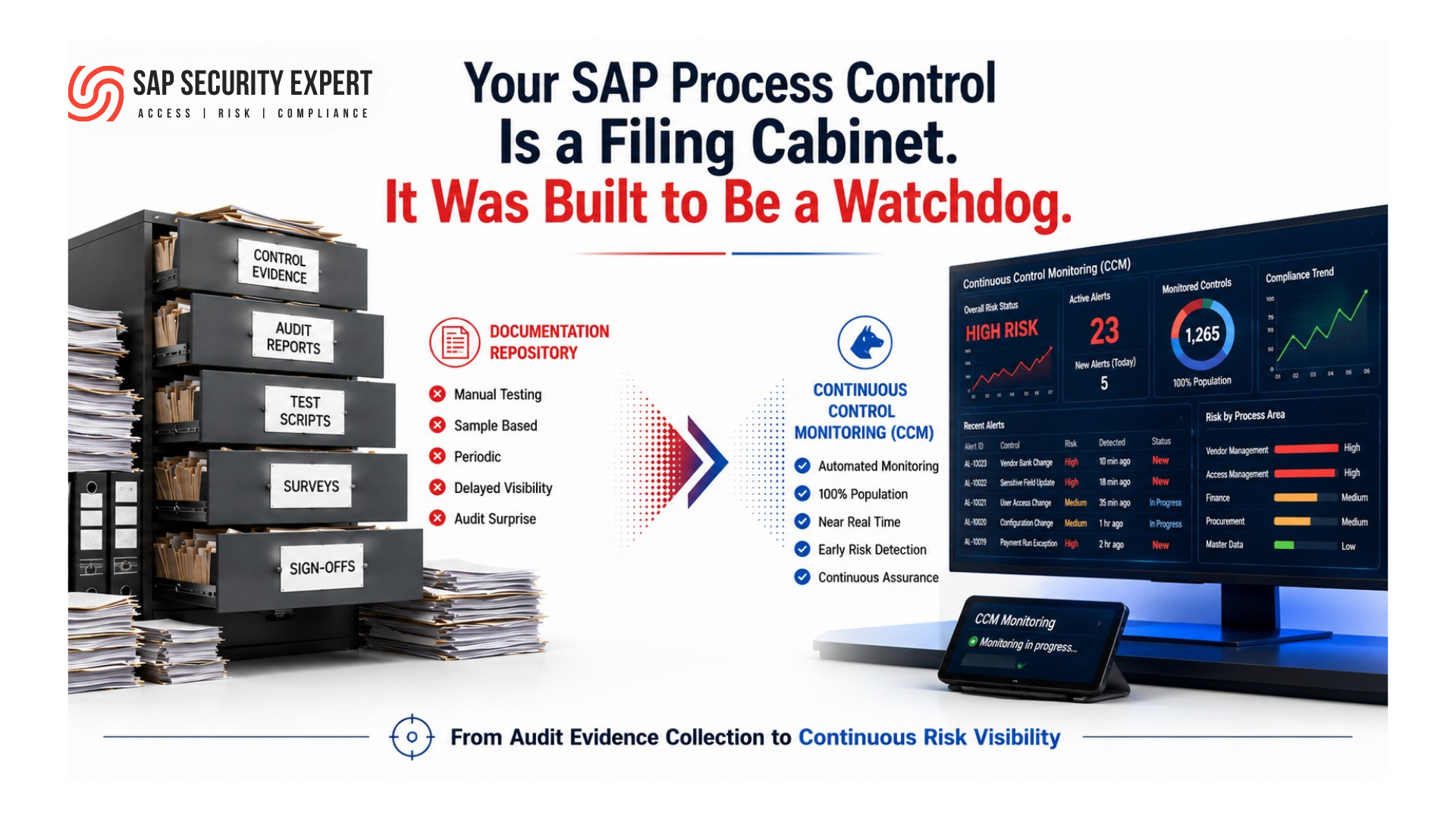
That is the problem. Enterprises bought a watchdog, but many are using it like a filing cabinet.
Continuous Control Monitoring (CCM) transforms this approach by continuously monitoring the entire transaction population in (near) real time, enabling organizations to identify and address issues before they become audit findings.
I frequently see organizations treating SAP Process Control as a place to document compliance rather than a platform to actively manage risk. Controls are recorded, surveys are completed, and evidence is archived, but it is not utilized as a platform to continuously monitor and determine whether the controls are actually operating effectively.
This is not unique to the projects that I handle. In a survey of nearly 200 CISOs for the State of Continuous Controls Monitoring report, 58 percent said they use GRC tooling to manage compliance evidence, yet only 5 percent considered their compliance program optimized for efficiency and continuous improvement. The tools are bought. The discipline they were meant to enable is not. The intent is almost universal, and the execution stalls while the license quietly renews.
The real cost is not only audit effort. It is delayed visibility. A control failure that could have been detected today often becomes an audit discussion months later. By then, the business has already carried the risk.
What manual testing actually costs you
Manual control testing runs on people. The team schedules walkthroughs, interviews process owners, pulls extracts, and evaluates a sample. By design it looks at a fraction of the population. By calendar it looks backward. A control that broke in week two of the quarter surfaces three months later, if the sample happens to catch it.
Manual testing also consumes expensive time from control owners, auditors, SAP teams, and process teams. Everyone participates in evidence collection, but the organization still gets only partial assurance.
Two structural problems live inside that model. Coverage is the first. A sample tells you something about twenty five transactions and nothing reliable about the other forty thousand. Latency is the second. By the time a failure surfaces, the exposure has already run for a quarter, and remediation turns into an audit conversation instead of an operational fix.
The uncomfortable reality is that organizations spend hundreds of hours testing controls and still cannot confidently answer whether those controls operated effectively every day during the reporting period.
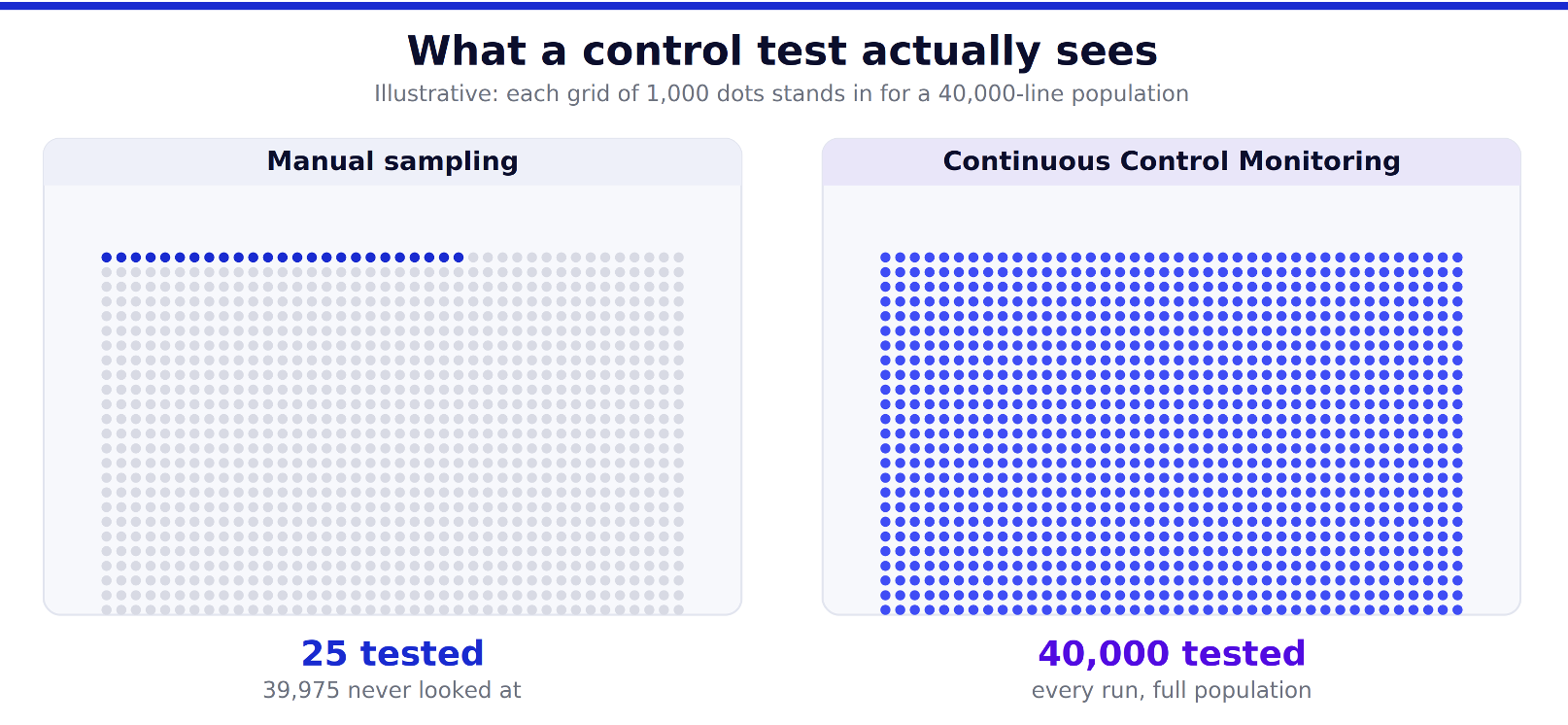
During a recent controls review, the team presented detailed test evidence and a control that had passed every assessment over the previous quarter. Everything looked compliant on paper. However, when asked whether the control had been operating effectively every day during those 90 days, there was no clear answer. The assessments were based on a limited sample of transactions, leaving a significant portion of activity untested.
You are spending audit-grade effort to produce evidence that is partial and already stale. That is the baseline CCM was built to replace.
The irony is that organizations often invest significant time and resources in control testing while still operating with incomplete visibility into actual control performance.
What SAP Continuous Control Monitoring (CCM) Does Instead
Continuous Control Monitoring (CCM) runs automated business rules directly against your source data and flags deviations to the control owner in near real time. The difference is not incremental. It changes what a control test is.
Coverage moves from a sample to the full population. Instead of testing twenty five purchase orders, the rule evaluates every purchase order that meets the condition. Frequency becomes a setting, not a project. A high-risk control can run hourly or daily, a lower-risk one monthly or quarterly, tied to criticality rather than to the audit calendar. When a deviation appears, the issue is raised and routed to an owner while the exposure is still small, not after the period has closed.
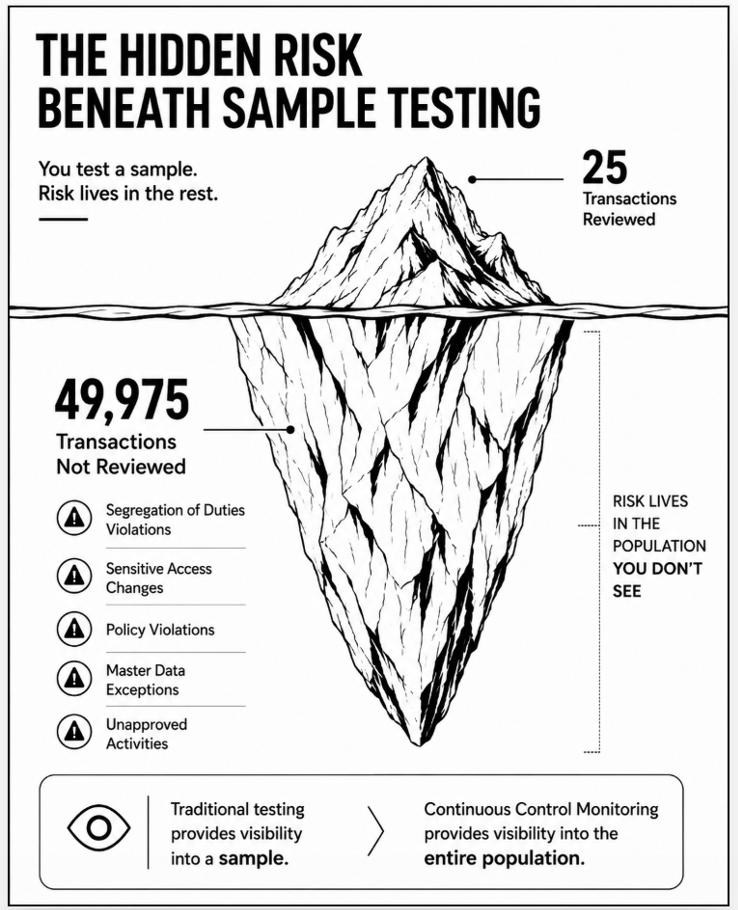
For example, instead of reviewing 25 vendor master changes at quarter-end, a CCM rule can monitor every vendor bank account change, every sensitive field update, or every high-risk configuration change as it happens. The question changes from “Did our sample pass?” to “What actually happened across the full population?”
SAP Process Control supports multiple CCM scenarios, including ABAP report-based monitoring, configurable change monitoring, and monitoring of external or non-SAP data sources. In SAP GRC 12.0, Monitor Value analysis allows teams to check values returned by standard or custom reports. The result is not just documentation, but a continuously measured control with an exception trail.
Why it stays off
If CCM is this clearly better, the fair question is why so many companies are using SAP PC instances in document-repository mode. The reasons are consistent, and none of them are the technology.
In most organizations, CCM does not fail because of SAP. It fails because ownership, rule design, and operating discipline are not clearly defined.
Rule design is real work. A business rule has to encode the control logic precisely, point at the right data source, and set thresholds that catch genuine failures without drowning owners in false positives. Teams underestimate this and stall at the first noisy rule.
Ownership is unclear. CCM sits on the boundary between the controls function, the SAP Basis and security team, and the process owners who answer the alerts. When no single role owns the backend rules and the connections behind them, the rollout has no home. This is the same ownership vacuum that quietly degrades most GRC and platform deployments, and it is usually the actual blocker hiding behind “we will get to automation next year.”
Fear of the exception queue. Once a rule runs against the full population it will surface issues the sample never caught. That is the point, but for a team already stretched by manual testing it reads as more work rather than less, so the rule gets disabled instead of tuned.
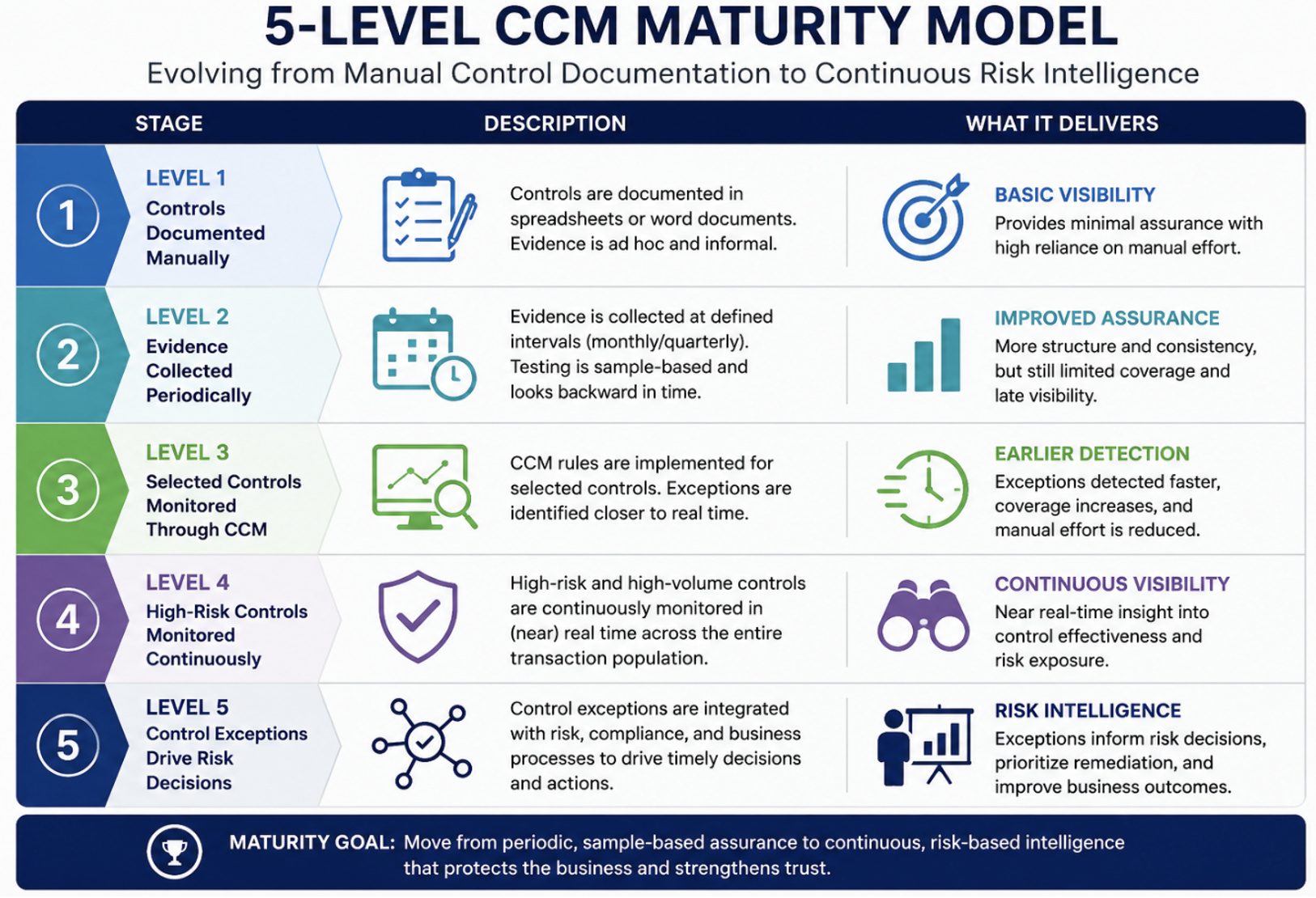 5-Level CCM Maturity Model
What CCM Is Not:
- A replacement for every manual control
- An audit-only initiative
- Another compliance reporting dashboard
What CCM Is:
- Continuous testing of control effectiveness
- Early detection of risk indicators
- Continuous visibility across the transaction population
- • Measurable evidence of control performance
How to Implement SAP Process Control CCM Successfully
You do not need to automate the whole control catalogue to justify CCM. You need to prove the model on the controls where manual testing hurts most.
A practical CCM rollout should not begin with the entire control catalogue. Start with 5 to 10 controls where the value is obvious: high-volume, high-risk, and frequently tested controls.
Start with the high-volume, high-risk controls, the ones where a sample is least defensible and a failure is most expensive. Configuration-sensitive controls, segregation-relevant postings, and master data integrity checks are good first candidates because the logic is testable and the population is large.
Build a small number of business rules and tune them deliberately before scaling. GRC 12.0 makes this easier than earlier releases did. Rules can run standalone, without being assigned to a control, so you can validate the logic and calibrate thresholds before you wire them into the formal control framework. You can also combine a CCM rule with a manual test plan on the same control, using the rule output as the basis for the tester’s judgment, which gives the controls team a bridge rather than a cliff.
The mechanics underneath this, the data source types, business rules, monitoring jobs, transports, and Job Monitor reporting, are where most teams stall. I walk through the full setup step by step in my book, SAP Process Control: The Comprehensive Guide (SAP PRESS), for readers who want the configuration detail this article has no room for.
Then make the results visible. With Support Package 19, Process Control delivers CCM issue dashboards through SAP Analytics Cloud over a live connection to the S/4HANA backend, so deviations and resolution status surface to management without a manual reporting cycle.
The unified 12.0 platform also pays off here. Process Control, Access Control, and Risk Management share organizations, processes, and controls on one ABAP stack, so a control you automate in Process Control can serve as a mitigating control in Access Control without being maintained twice. Also, the controls defined in process control can act as response for a risk in Risk Management to calculate the residual risk levels. The automation compounds across the suite instead of staying trapped in one module.
The license is not the control
A control is not effective because it is documented. It is effective when it detects risk at the right time and drives action.
SAP Process Control already has the capability to move organizations from periodic review to continuous visibility. SAP Process Control was never designed to be a repository of completed assessments. It was designed to provide continuous visibility into control performance. Organizations that embrace CCM move from proving compliance after the fact to identifying risk while there is still time to act.
If your SAP Process Control environment is still used mainly for documentation and evidence collection, this is the right time to review your CCM readiness. Organizations do not need more control documentation. They need better control visibility. Start with a small set of high-risk controls, prove the value of CCM, and then expand the model across the control framework.
About the author
Raghu Boddu is the co-founder and CEO of ToggleNow and co-author of SAP Process Control: The Comprehensive Guide (SAP PRESS, 2024), along with SAP Access Control 12.0: The Comprehensive Guide and Introducing SAP Cloud Identity Access Governance. He holds the CISA, CFE, and CDPSE certifications, has more than 25 years in SAP security, GRC, audit, and automation, and writes on SAP security and governance at sapsecurityexpert.com.
References
- RegScale, The State of Continuous Controls Monitoring report (survey of nearly 200 CISOs; 58% use GRC tooling to manage compliance evidence, 5% consider their program optimized).
- SAP PRESS, “Introduction to Continuous Control Monitoring in SAP” (100% population testing, near real-time alerting).
- Turnkey Consulting, “How to start with continuous controls monitoring in SAP” (CCM maturity, ownership and alignment gaps).
- SAP Help Portal, SAP Process Control 12.0 Administration Guide (unified GRC 12.0 platform; shared organizations, processes and controls across AC, PC and RM).
- SAPinsider, “What’s new in SAP Process Control and SAP Risk Management version 12.0” (standalone CCM business rules; CCM rules combined with manual test plans).
- SAP Community, “SAP Process Control ABAP Report Monitor Value Scenario (12.0)” (Monitor Value analysis type).
- SAP Community, “Continuous Control Monitoring Issues Dashboards for SAP Process Control” (Support Package 19; SAP Analytics Cloud live connection to S/4HANA).
- Raghu Boddu and Ramakrishna Chaitanya, SAP Process Control: The Comprehensive Guide, SAP PRESS, 2024, ISBN 9781493225101.